

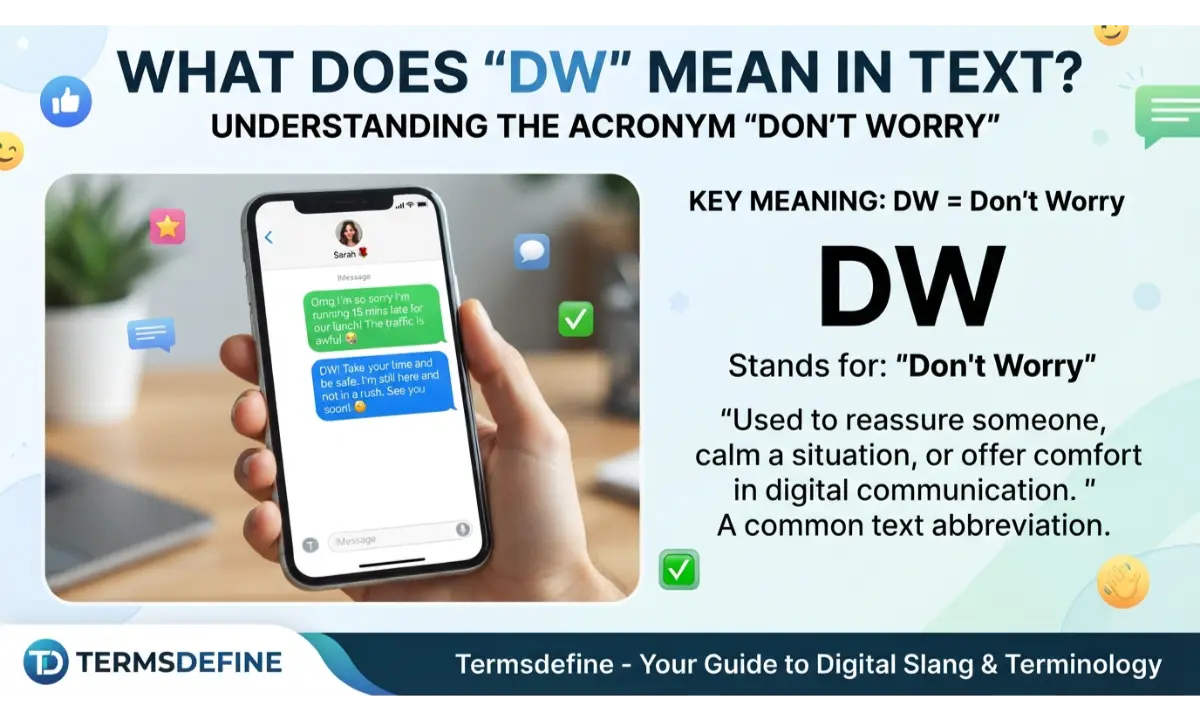
Meta Description: Learn the DW meaning in text, including “don’t worry,” social media usage, examples, tone, alternative meanings, and how to respond.
If someone sends you “DW” in a text, DM, or group chat, they are usually telling you not to worry. This tiny abbreviation is common in casual digital communication because it delivers reassurance without requiring a full sentence.
You may see it after an apology, a question about being late, or a message from someone who feels nervous about something. Understanding the DW meaning in text is therefore less about decoding complicated slang and more about recognizing the conversational situation around it In most everyday texting, DW means “don’t worry.
However, the same letters can have another meaning in some online communities, where DW can refer to a “dear wife” or “darling wife.” This guide explains both meanings, how tone changes with context, realistic examples, and when DW is appropriate to use.
Quick Answer
DW usually means “don’t worry” in text messages, chats, and social media. It is an informal way to reassure someone, dismiss a small concern, or respond to an apology. In some family or relationship-focused online communities, DW can also mean “dear wife” or “darling wife.”
What Does DW Mean in Text?
In ordinary texting, DW means “don’t worry.” It is an initialism formed from the first letters of “don’t” and “worry.”
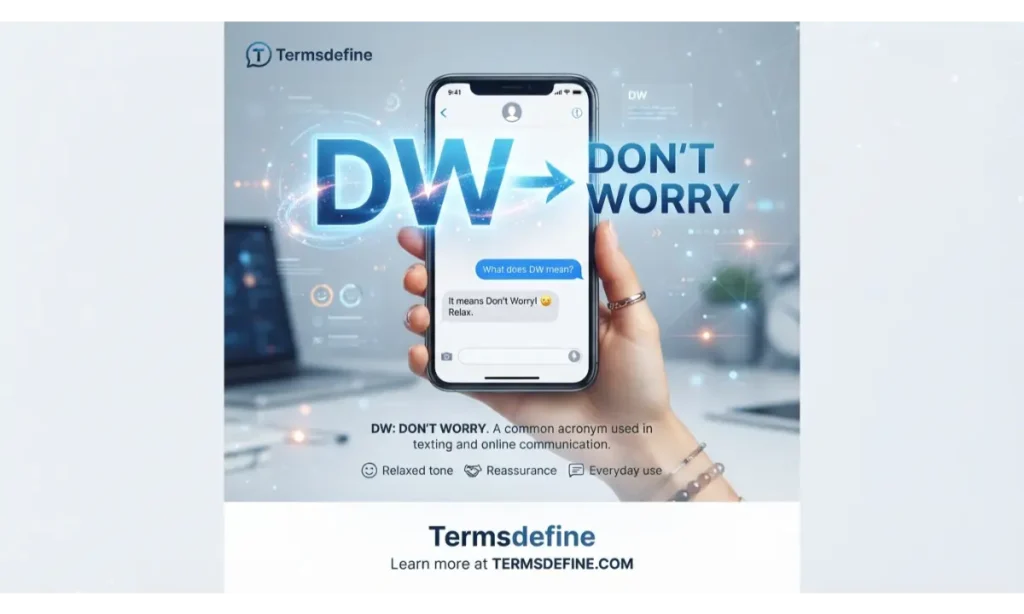
For example:
Alex: Sorry, I forgot to call you.
Sam: DW, it’s okay.
Here, Sam is reassuring Alex that the missed call is not a serious problem. Dictionary references identify “don’t worry” as a messaging and social-media meaning of DW.
What Is the Full Form of DW?
The most common full form of DW in casual digital communication is “Don’t Worry.”
It is generally used as a short reassurance. Depending on the situation, it can communicate:
- Don’t stress.
- It’s okay.
- No problem.
- You’re fine.
- There is nothing to worry about.
The exact emotional meaning depends on the surrounding conversation. DW Meaning in Texting
In texting, DW is useful when someone expresses concern or apologizes.
For example:
“Sorry I’m going to be 15 minutes late.”
“DW, take your time.”
The response does more than shorten “don’t worry.” It also signals that the sender is not upset about the delay.
USA TODAY similarly describes DW as a texting abbreviation used to reassure someone that a situation is okay.
4. DW Meaning on Social Media
DW can appear in social media comments, direct messages, group conversations, and other informal online spaces. The meaning usually remains “don’t worry.”
For example:
“DW, I saved the post for you.”
On social platforms, people often prefer short expressions because conversations move quickly. Still, context matters. If DW appears in a sentence about someone’s spouse, the alternative meaning may be more appropriate.
DW Meaning on Snapchat, Instagram, TikTok, and WhatsApp
On platforms such as Snapchat, Instagram, TikTok, and WhatsApp, DW generally follows the same texting meaning: “don’t worry.”
You might see:
“DW 😂 I wasn’t mad.”
or:
“DW, we can do it tomorrow.”
The platform itself normally does not create a different definition. The surrounding message provides the clue.
DW Meaning in a Conversation
DW can help close a small concern without turning it into a longer discussion.
Imagine a friend says:
“I think I accidentally sent you the wrong file.”
You might reply:
“DW, I can use the other one.”
In this situation, DW reassures the other person that the mistake is manageable. It can also make the conversation feel relaxed and less formal.
What Tone Does DW Have?
DW is usually casual, reassuring, and friendly. However, a two-letter response does not automatically guarantee a particular emotional tone.
Compare:
“DW ❤️”
with:
“dw.”
The first may feel warmer because of the heart emoji. The second may feel brief or neutral. Neither should be interpreted without considering the conversation, relationship, punctuation, and surrounding messages.
Texting lacks vocal tone, so context can change how short replies are perceived. Does DW Mean the Same Thing From a Girl?
If a girl sends “DW” in a normal text conversation, the abbreviation generally still means “don’t worry.”
It does not have a special female-specific definition. For example:
“Sorry, I forgot your book.”
“DW, bring it tomorrow.”
The relationship between the two people may affect the emotional tone, but the abbreviation itself does not change meaning simply because the sender is a girl.
Does DW Mean the Same Thing From a Guy?
Yes. If a guy sends “DW” in an ordinary chat, it generally means “don’t worry.”
For example:
“I might be late.”
“DW, we haven’t started yet.”
There is no reliable gender-specific interpretation. Focus on the words around DW rather than trying to decode the sender’s gender.
DW in Friendship and Casual Chats
Among friends, DW is particularly natural because the conversation is informal.
A friend might write:
“Sorry for canceling yesterday.”
“DW, we’ll hang out this weekend.”
Here, DW helps reduce tension and communicates acceptance.
It can also be used proactively:
“DW, I’ll bring snacks.”
In that example, the sender is reassuring the other person before they even express concern.
DW in Romantic Conversations
Couples and people who are dating may also use DW as a quick reassurance.
For example:
“Sorry, today was crazy and I couldn’t reply.”
“DW ❤️ I understand.”
The abbreviation itself is not inherently romantic. The relationship, additional words, emojis, and overall conversation create that context.
A plain “DW” can therefore be caring, neutral, or simply practical depending on the situation.
What Does DW Mean in a Relationship?
In relationship conversations, DW most often means “don’t worry.” It can reassure a partner about a minor problem, misunderstanding, delay, or mistake.
For example:
“Are you upset with me?”
“DW, I’m just tired.”
Here, DW helps communicate that the other person does not need to become anxious about the situation.
It should not, however, be treated as proof of a person’s feelings. The rest of the conversation provides the meaningful context.
Can DW Mean “Dear Wife” or “Darling Wife”?
Yes. “Dear wife” and “darling wife” are recognized alternative meanings of DW, particularly in some social-media and relationship-oriented contexts. Oxford and Collins both list these meanings.
For example:
“My DW made this amazing cake.”
Here, “don’t worry” would make no sense. The writer is referring to their wife.
This usage is much easier to identify when DW appears next to possessive words such as “my.”
How to Tell Which DW Meaning Applies
Context usually solves the mystery.
“DW, everything is fine.”
→ Don’t worry
“My DW is joining us tonight.”
→ Dear/darling wife
The grammatical position also helps. When DW is used as a direct response to concern or apology, “don’t worry” is the natural interpretation. When it describes a person, especially someone’s wife, the relationship-related meaning may apply.
Real Text Examples Using DW
Here are several natural examples:
Friendship
“Sorry I’m late.”
“DW, we just got here.”
Group chat
“I forgot to send the address.”
“DW, I already have it.”
Dating
“Sorry for disappearing yesterday.”
“DW, no big deal.”
General reassurance
“I might mess this up.”
“DW, you’ve got this.”
These examples show that the core idea stays the same: reassurance.
How Should You Respond to DW?
Your response depends on what the other person means and what you want to say.
If they mean “don’t worry,” you can respond with:
- “Thanks!”
- “Okay, appreciate it.”
- “Got it 😊”
- “That’s good to hear.”
- “Thanks for understanding.”
If someone uses DW to refer to their wife, respond to the actual subject instead:
“My DW is coming too.”
You could simply say:
“Nice! Tell her I said hi.”
Understanding the context matters more than memorizing a fixed response.
Is DW Formal or Informal?
DW is informal and is best suited to casual digital communication.
It can work naturally in:
- Text messages
- DMs
- Group chats
- Casual social media conversations
- Conversations with friends and family
Avoid using it in formal documents, academic assignments, job applications, or professional emails unless the communication style specifically allows casual abbreviations. In formal writing, simply write “don’t worry” or another appropriate phrase.
Common Misunderstandings About DW
One common mistake is assuming that DW always means “don’t worry.” Dictionaries also recognize “dear wife” and “darling wife” as alternative meanings.
Another mistake is assuming that a short “DW” is automatically warm or cold. Tone depends on context.
Finally, DW should not be confused with similar abbreviations such as BTW, IDK, or NVM. Each has a different function.
DW vs. Similar Texting Abbreviations
DW is close in purpose to several casual expressions, but they are not identical.
| Abbreviation | Meaning | Common purpose |
|---|---|---|
| DW | Don’t worry | Reassurance |
| NP | No problem | Responding to thanks/apologies |
| NVM | Never mind | Dropping or correcting a topic |
| IDK | I don’t know | Showing uncertainty |
| BTW | By the way | Adding information |
For example, if someone says “Sorry,” DW may fit naturally. If someone says “Thanks,” NP is usually more appropriate.
Why DW Is Useful in Digital Communication
DW works because it compresses a familiar phrase into two letters while preserving its basic conversational purpose. Like many texting abbreviations, it makes casual communication quicker.
The important point is not simply knowing the letters. Understanding context makes the abbreviation useful. In most everyday messages, DW means “don’t worry,” while a sentence about someone’s wife may point to the alternative meaning.
Takeaways
- DW usually means “don’t worry” in texting and casual online communication.
- It is commonly used to reassure someone or dismiss a minor concern.
- DW can sound friendly, neutral, or slightly dismissive depending on context.
- In some online contexts, DW can mean “dear wife” or “darling wife.”
- DW is informal and is generally better suited to casual conversations than formal writing.
FAQs
What does DW mean in text?
DW usually means “don’t worry.” It is a casual texting abbreviation used to reassure someone or tell them that something is not a problem.
What does DW mean on social media?
On social media, DW generally means “don’t worry.” The same abbreviation may occasionally refer to “dear wife” or “darling wife” depending on context.
What does DW mean from a girl?
It normally means “don’t worry.” There is no separate female-specific definition.
What does DW mean from a guy?
It normally means “don’t worry.” The sender’s gender does not change the standard texting meaning.
What does DW mean in a relationship?
Usually, it means “don’t worry” and can be used to reassure a partner. In some contexts, DW can also mean “dear wife” or “darling wife.”
How do you respond to DW in text?
If DW means “don’t worry,” responses such as “Thanks,” “Okay,” or “I appreciate it” can work naturally.
Is DW formal or informal?
DW is informal. Use “don’t worry” instead in formal emails, academic writing, applications, and official communication.
Can DW have another meaning?
Yes. Oxford and Collins recognize “dear wife” and “darling wife” as alternative meanings in certain online contexts.
Conclusion
The most common DW meaning in text is “don’t worry.” People use it as a quick, casual way to reassure someone, respond to an apology, or show that a small problem is not serious. In some relationship-focused online conversations, DW can instead mean “dear wife” or “darling wife.”
The surrounding words usually make the intended meaning clear. As with most texting abbreviations, the letters are only part of the message; context, punctuation, emojis, and the relationship between the speakers can all affect how DW sounds.

My name is Tayyab Abbas, and I am the lead content author at TermsDefine.com. Holding a Master’s degree in English along with 5+ years of dedicated linguistic research experience, I focus on transforming complex terminology, word definitions, and technical jargon into clear, easy-to-understand explanations. Every entry, context guide, and meaning published on this platform is thoroughly researched, drafted, and verified by me to maintain the highest standards of accuracy and real-world clarity. My objective is to provide readers with an authoritative, dependable dictionary resource for all their vocabulary needs.
1 thought on “DW Meaning in Text: What Does DW Mean in Texting?”