

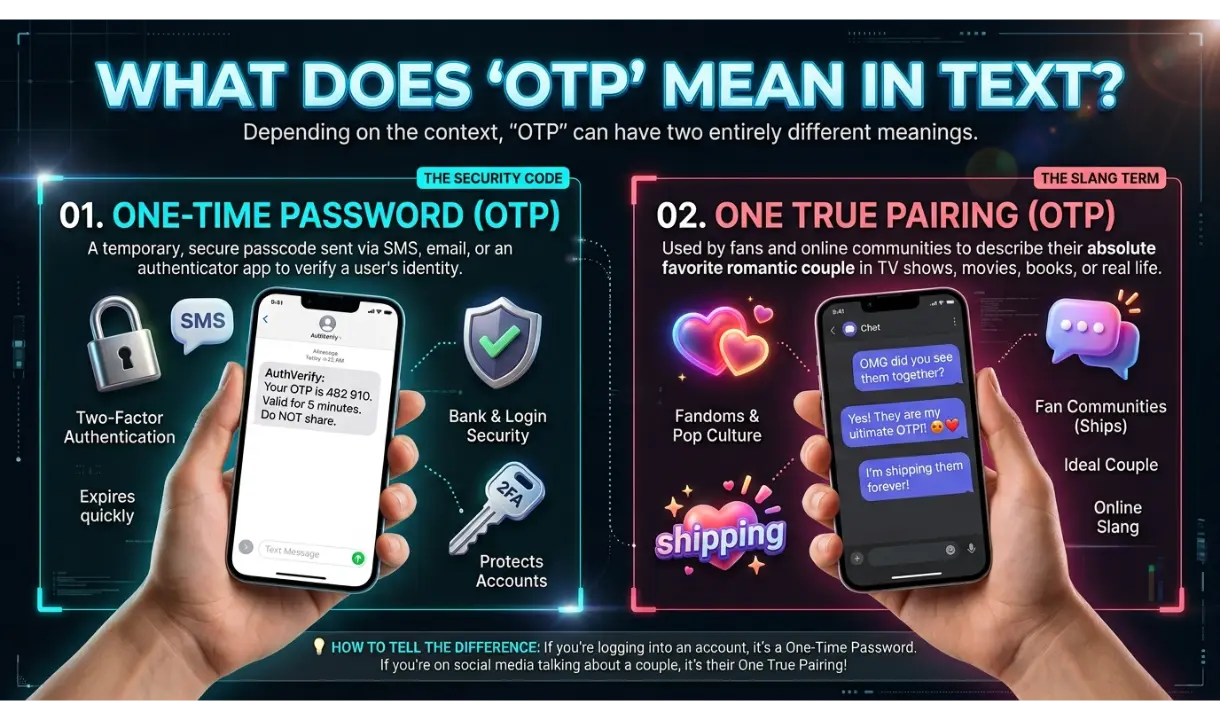
If you have received a message containing “OTP,” you might wonder what it means and why someone is using it. The OTP meaning in text depends on the conversation, but two common interpretations are “One-Time Password” and “One True Pairing.”
In everyday digital communication, a one-time password is a temporary security code used to verify your identity, while One True Pairing is a phrase used by fans who love a particular fictional or celebrity couple. Understanding the context is the easiest way to tell which meaning someone intends.
You might see OTP in a message from your bank, a login verification notification, a WhatsApp conversation, or a social media post about a favorite TV show. This guide explains the abbreviation, its different meanings, realistic examples, and ways to respond so you can understand OTP without confusion.
Quick Answer
OTP usually stands for “One-Time Password” in account security and verification messages. On fandom and entertainment social media, it can mean “One True Pairing,” referring to someone’s favorite romantic couple. The surrounding conversation tells you which meaning applies.
What Does OTP Stand for in Text?
OTP is an abbreviation with several meanings, so the topic of a message matters. In security-related messages, it stands for “One-Time Password” or “One-Time Passcode,” a temporary code used to verify identity.
In fandom conversations, OTP stands for “One True Pairing,” meaning someone’s favorite romantic couple. In some casual chats, people also use it to mean “on the phone,” although this interpretation is less universal.
For example:
- “Enter the OTP to continue.” — A verification code.
- “Those two are my OTP.” — A favorite couple.
- “Sorry, I’m OTP.” — Possibly on the phone.
Always check the surrounding words before deciding what the abbreviation means.
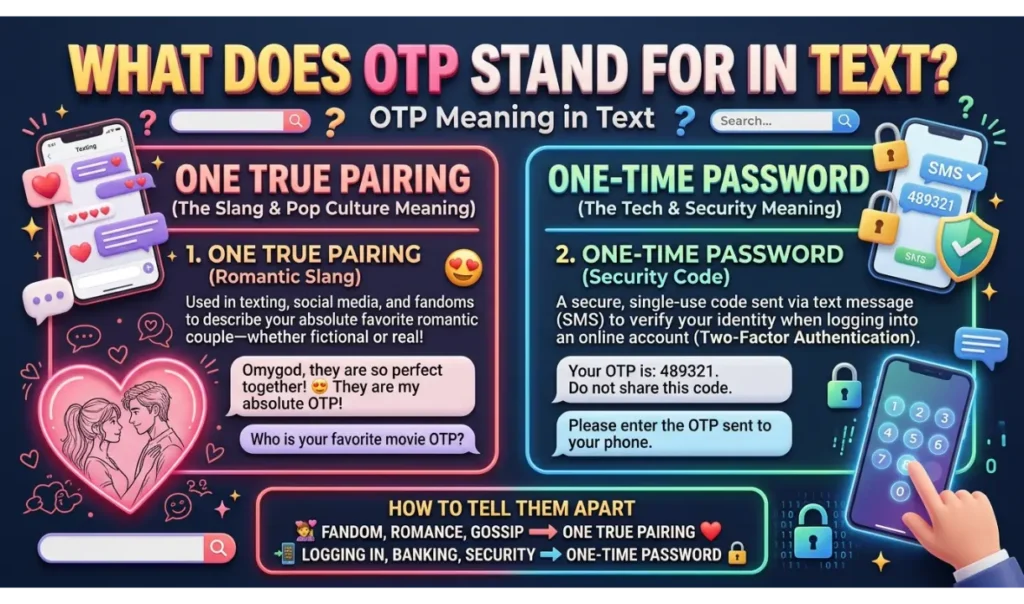
OTP Meaning in Text Messages
When OTP appears in a regular text message, its meaning depends on the conversation. A friend talking about a television series may mean “One True Pairing,” while someone explaining why they cannot talk may mean “on the phone.”
Here are a few realistic examples:
- Friend: “Have you watched that new show?”
- You: “Yes! The main characters are my OTP.”
In another conversation:
- Friend: “Why aren’t you answering?”
- You: “I’m OTP with my cousin. I’ll call you later.”
These examples show why context matters. If the message is about a login or payment, OTP almost certainly refers to a verification code rather than texting slang.
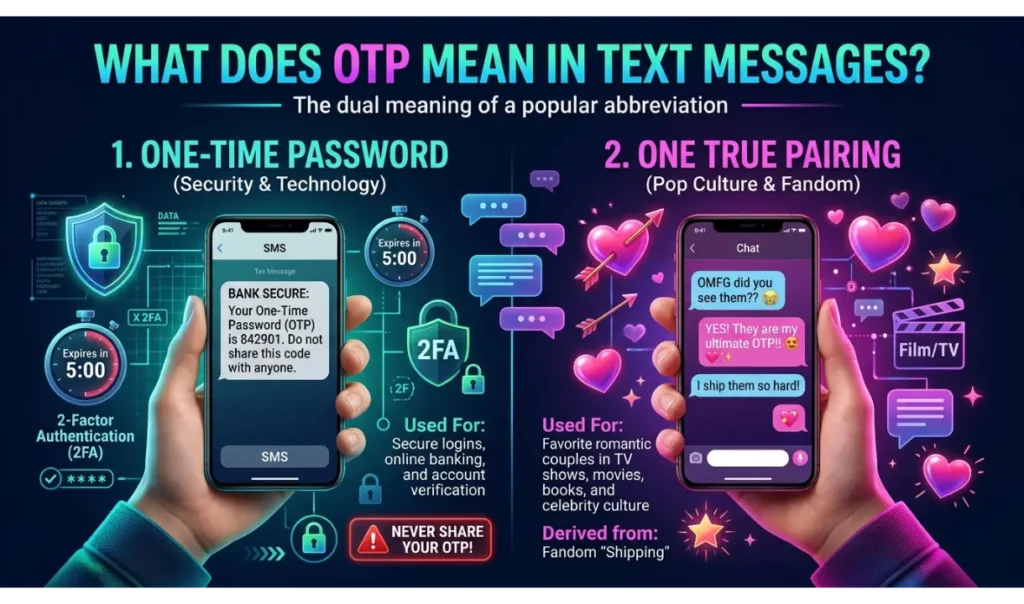
OTP Meaning on Social Media
On social media, OTP often appears in posts about fictional relationships, celebrities, movies, books, and television shows. Fans use it to express strong support for a couple they particularly like.
For instance, someone might post a picture of two characters with the caption, “My OTP forever!” This means the person loves the pairing and enjoys seeing those characters together.
On platforms such as Instagram, TikTok, Reddit, and X, the term may appear in captions, comments, fan edits, and discussions. The meaning is not identical in every community, however.
If a social media post discusses account access or verification, OTP may instead refer to a one-time password.
OTP Meaning on WhatsApp and Snapchat
On WhatsApp and Snapchat, OTP can have different meanings depending on the conversation. In a private chat, someone discussing their favorite characters might use it to mean “One True Pairing.”
A person may also use OTP as shorthand for “on the phone,” but this is informal and may not be understood by everyone.
Examples:
- “They look so cute together. OTP!”
- “Can’t reply rn, OTP with Mom.”
The first message expresses enthusiasm for a couple. The second suggests the sender is busy on a call.
Neither platform assigns OTP one universal meaning for every conversation. If the message is unclear, asking what the sender means is perfectly reasonable.
OTP Meaning in Banking and Online Security
In banking and online security, OTP means “One-Time Password” or “One-Time Passcode.” It is a temporary code that helps verify your identity when signing in, confirming an action, or accessing an account.
For example:
“Your OTP is 482731. Enter it to verify your login.”
The code is intended for a specific verification process and should be treated as confidential. Never share it with someone who contacts you unexpectedly, even if they claim to represent your bank or a trusted company.
If you receive a code you did not request, do not use or disclose it. Check your account through the official app or website and contact the provider if necessary.
What Does OTP Mean From a Girl?
If a girl uses OTP in a conversation, her intended meaning depends on what you are discussing. There is no special definition that applies to girls alone.
If she writes, “They’re my OTP,” while discussing a series, she probably means her favorite couple. If she says, “I’m OTP right now,” she may mean she is on the phone.
For example:
- You: “Which couple do you like in this show?”
- Her: “Alex and Jamie are my OTP!”
This expresses her favorite pairing, not necessarily a romantic interest in you. Look at the conversation rather than assuming that the abbreviation is a hint or a flirtatious message.
What Does OTP Mean From a Guy?
A guy can use OTP in the same ways as anyone else. The abbreviation itself does not have a special male-specific meaning.
For example, he might comment “They’re my OTP” under a fan edit or message “I’m OTP, talk later” to explain why he is busy on a call.
If a guy uses OTP while talking about you and another person, he might be describing you as a couple he supports. However, that interpretation depends on the exact wording.
Avoid reading too much into the abbreviation alone. The surrounding conversation, relationship between the speakers, and tone provide better clues about his intention.
OTP Meaning in Relationships and Dating
In relationship discussions, OTP usually means “One True Pairing.” People use it to describe a couple they think is especially compatible or enjoyable to watch.
The term is popular in fandom culture, but people may also apply it playfully to real-life couples or celebrity relationships. It does not automatically mean that the couple is married, officially dating, or destined to stay together.
Example:
- Friend: “You two would make such a cute couple.”
- You: “Haha, are we your OTP now?”
This response is playful and may sound slightly flirty depending on your relationship. However, OTP is not a standard declaration of love. Consider the full message before deciding what the sender feels.
Realistic Examples of OTP in Text
Seeing OTP in complete sentences makes the different meanings easier to recognize.
| Message | Likely meaning |
|---|---|
| “They’re my OTP!” | Favorite couple |
| “OTP with my sister rn.” | On the phone |
| “Please enter your OTP.” | One-time password |
| “That fictional couple is still my OTP.” | Favorite romantic pairing |
| “I received an OTP to log in.” | Verification code |
The same abbreviation can communicate very different things. Pay attention to words such as “couple,” “show,” “call,” “login,” and “verify.”
These clues often make the intended meaning clear without requiring you to ask the sender.
How to Use OTP Correctly
Use OTP only when the context makes your intended meaning clear. In fandom conversations, it works naturally when discussing couples or character relationships.
For example, “They’re my OTP in this series” is easy to understand for someone familiar with fandom language.
If you mean “on the phone,” remember that this usage is informal and may confuse people who associate OTP with security codes. A clearer message is “I’m on a call right now.”
When discussing account verification, use OTP as the standard abbreviation for a one-time password or passcode.
For professional messages, spell out the meaning the first time if your audience may not recognize the abbreviation.
How to Respond When Someone Says OTP
Your response should match the meaning of the original message.
If someone says, “They’re my OTP,” you could reply:
- “They really do have great chemistry!”
- “I can see why you ship them.”
- “Who’s your second favorite couple?”
If someone says, “I’m OTP,” and means they are on a call, you could answer, “No problem, message me when you’re free.”
If a website asks you to enter an OTP, follow the instructions only if you initiated the legitimate login or transaction. Never send a verification code to another person through chat.
When you cannot tell which meaning applies, ask a simple question: “Do you mean on the phone or something else?”
Is OTP Slang or a Formal Abbreviation?
OTP can be either informal slang or a technical abbreviation. The difference depends on how it is being used.
“One True Pairing” belongs mainly to fandom and casual online communication. “On the phone” is an informal shorthand that some people use in messages.
“One-Time Password,” however, is an established technical term used in account security and digital services.
You can use the technical meaning in workplace communication when discussing authentication. In formal writing, explain the abbreviation when needed.
For casual meanings, use the term with people who understand the context. In an email to a teacher, client, or employer, writing the full phrase is usually clearer.
Common Misunderstandings About OTP
The biggest mistake is assuming OTP has only one meaning. Someone familiar with banking may immediately think of a verification code, while a fan may think of a favorite fictional couple.
Another misunderstanding is assuming OTP always has romantic significance. In a security message, it has nothing to do with relationships.
People can also misread “on the phone” if they have never encountered that informal usage.
To avoid confusion, consider:
- The source: Is it a bank, friend, app, or fan community?
- The subject: Is the conversation about a call, couple, or account?
- The wording: Does the surrounding sentence suggest a particular meaning?
If the clues are insufficient, ask for clarification instead of guessing.
Similar Abbreviations and Related Slang
Several abbreviations appear in conversations about relationships or digital security, but they do not all mean the same thing.
- Ship: To support or want a romantic pairing, often involving fictional characters.
- Canon: Something officially established in a fictional story.
- Endgame: A relationship that fans expect or hope will last until the end of a story.
- OTP code: A one-time verification code used for authentication.
- PIN: A personal identification number used to verify access or authorize certain actions.
In fandom discussions, “ship” is broader than OTP: you can support several pairings but have one favorite OTP.
In security settings, a PIN and an OTP are not necessarily interchangeable. A PIN may remain the same, while an OTP is designed for limited use or validity.
When Should You Avoid Using OTP?
Avoid using OTP without explanation when communicating with people who may not know the abbreviation. Its multiple meanings can cause unnecessary confusion.
For example, telling a colleague “I’m OTP” may not clearly explain whether you are on a call or referring to something else.
In job applications, academic writing, formal reports, and official documents, write the complete phrase unless the abbreviation is clearly established in that field.
There is also an important security rule: never share a one-time password in an ordinary chat just because someone asks for it. A person who obtains your code may attempt to access your account.
Use straightforward language whenever clarity, professionalism, or account safety matters.
Does OTP Have Different Meanings on TikTok and Instagram?
Yes. OTP can refer to a favorite couple in entertainment-related posts on both platforms. A creator might upload an edit of two characters with the caption “My OTP,” showing support for their relationship.
On Instagram, the abbreviation may appear in fan pages, reels, comments, and stories. On TikTok, it may accompany edits, reaction videos, or discussions about fictional couples.
However, the platform alone does not determine the meaning. A message about account verification still uses OTP in the security sense. Read the caption, video, or surrounding comments before interpreting the abbreviation.
What Is the Origin of OTP?
OTP has more than one expansion, so it does not have a single origin story that explains every use. “One-time password” belongs to computing and authentication, while “One True Pairing” is associated with online fandom language.
The fandom expression became familiar in online discussions about favorite couples and fictional relationships. Fans use it to show which pairing they support most strongly.
The exact first use of the abbreviation in everyday texting is not established by the sources consulted here. It is best to avoid claiming that one person, website, or social media platform invented every meaning of OTP.
How Do You Know Which OTP Meaning Applies?
Use the message’s subject and source as your first clues.
- Login or banking message: One-Time Password.
- Discussion about a fictional couple: One True Pairing.
- A friend explaining a delay during a conversation: Possibly “on the phone.”
For example, “Your OTP expires soon” is a security-related message. “They are my OTP” is probably about a favorite couple.
If the message simply says “OTP,” there may not be enough information to identify its meaning confidently. Ask the sender what they mean rather than relying on assumptions.
Can OTP Have Other Meanings?
Yes. OTP has technical and specialized meanings beyond everyday texting. In cryptography, for example, OTP can stand for “One-Time Pad,” a different concept involving encryption.
The abbreviation may also be used differently in particular workplaces, communities, or personal conversations. However, obscure expansions should not be treated as common texting meanings without evidence.
For most readers, the most useful interpretations are “One-Time Password,” “One True Pairing,” and, in some informal conversations, “on the phone.”
If none fits the message, consider the subject and ask for clarification.
Why Understanding OTP Matters
Knowing what OTP means helps you interpret messages accurately and avoid misunderstandings. A phrase used to praise a fictional couple has a very different purpose from a code that protects your online account.
Understanding the context is especially important when security is involved. A verification code should remain private, even if a message appears urgent or comes from someone claiming to be trustworthy.
In everyday chats, the abbreviation can make conversations shorter, but not every reader will know every meaning. When clarity matters, writing the complete phrase is the simplest solution.
Key Takeaways
- OTP commonly means One-Time Password in security messages.
- In fandom conversations, OTP means One True Pairing, or a favorite couple.
- Some people use OTP informally to mean on the phone.
- The surrounding conversation helps identify the intended meaning.
- Never share a one-time verification code with another person.
- Use the complete phrase when an abbreviation could confuse your audience.
FAQs About OTP Meaning in Text
What does OTP mean in text?
OTP can mean One-Time Password, One True Pairing, or, in some casual conversations, on the phone. Context determines the intended meaning.
What does OTP mean on social media?
In fandom posts, OTP usually refers to a favorite romantic pairing, such as two characters from a TV show or book.
What does OTP mean from a girl or a guy?
The abbreviation has no special gender-specific meaning. Its interpretation depends on the topic and the wording of the message.
What does OTP mean in a relationship?
It generally means One True Pairing, describing a couple someone especially likes or supports. It does not automatically indicate romantic interest in the person receiving the message.
Is OTP the same as a PIN?
No. A PIN is a personal identification number, while a one-time password is intended for limited use or validity. They serve related but distinct security purposes.
Is OTP formal or informal?
“One-Time Password” is a technical term suitable for professional contexts. “One True Pairing” and “on the phone” are informal uses associated with online fandom and casual conversation.
Conclusion
The OTP meaning in text depends on context. It can refer to a One-Time Password used for security, a One True Pairing discussed by fans, or informally, being on the phone.
Check the surrounding message to understand which meaning fits. When security codes are involved, keep them private and use them only for legitimate verification.

My name is Tayyab Abbas, and I am the lead content author at TermsDefine.com. Holding a Master’s degree in English along with 5+ years of dedicated linguistic research experience, I focus on transforming complex terminology, word definitions, and technical jargon into clear, easy-to-understand explanations. Every entry, context guide, and meaning published on this platform is thoroughly researched, drafted, and verified by me to maintain the highest standards of accuracy and real-world clarity. My objective is to provide readers with an authoritative, dependable dictionary resource for all their vocabulary needs.