

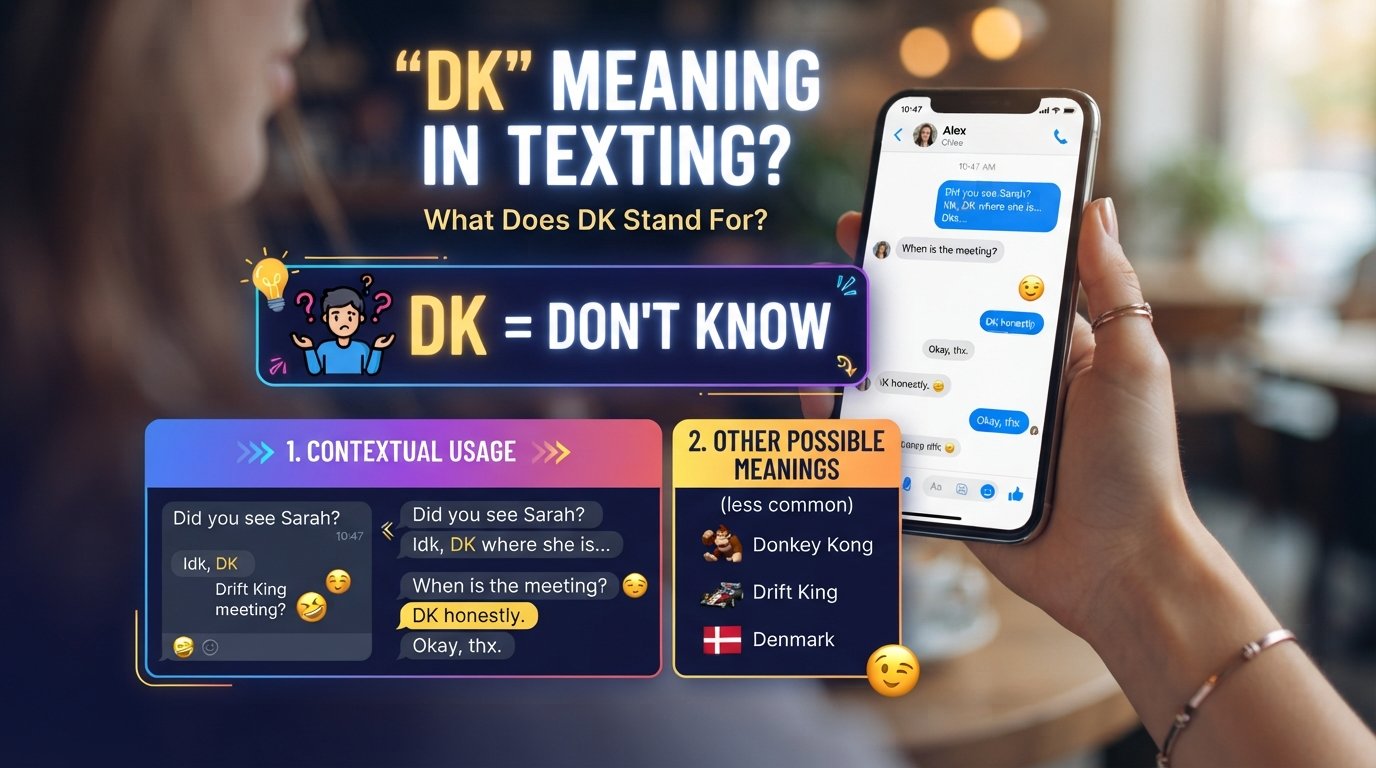
If someone replies to your message with “DK,” you may wonder if they are confused, uninterested, or simply using another piece of internet slang. In most casual texting situations, DK means “don’t know.”
It is a short way to say that someone does not have an answer, is uncertain, or has not decided yet. You may see it in text messages, group chats, social media conversations, gaming discussions, or direct messages. Because short abbreviations can carry different meanings in different communities, context still matters.
A message such as “DK yet” is usually easy to understand, while “DK” inside a gaming or entertainment conversation may refer to something completely different. This guide explains the DK meaning in text, how it sounds, how people use it with friends or while dating, how to respond, and when a different meaning may apply.
Quick Answer
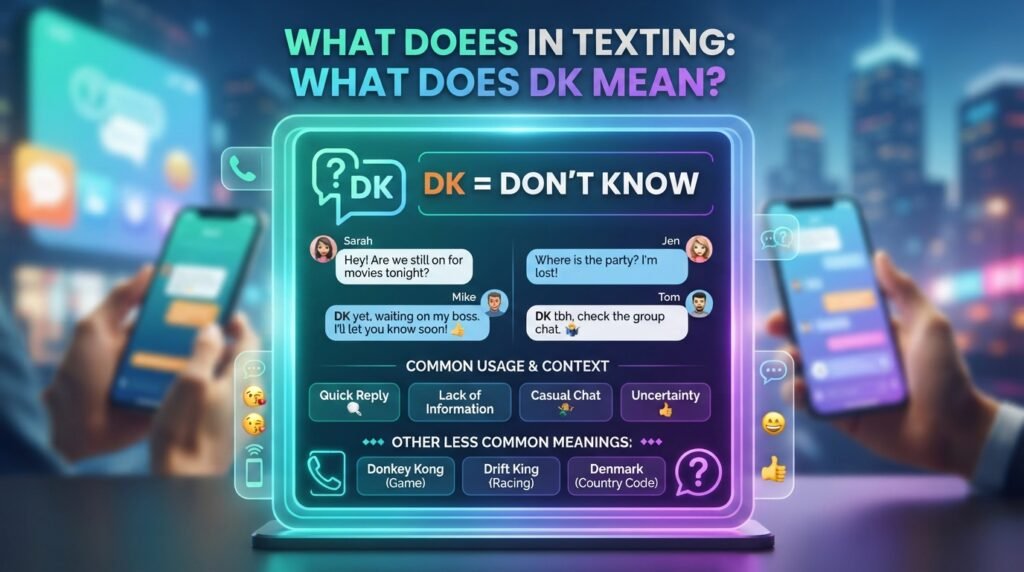
DK usually means “don’t know” in texting and online conversations. It is an informal abbreviation used when someone does not know the answer or is unsure about something. In other contexts, DK can refer to things such as Donkey Kong or Denmark, so the surrounding conversation is important.
What Does DK Mean in Text?
The most common DK meaning in text is “don’t know.” It is a compact alternative to saying “I don’t know.”
For example:
Person A: “What time are they arriving?”
Person B: “DK yet.”
Here, the sender means they do not know the arrival time yet.
You can also see it in phrases such as:
- “DK where he went.”
- “DK what happened.”
- “DK if I can come.”
- “DK, ask her.”
The abbreviation is informal and works best when both people understand casual texting language.
What Is the Full Form of DK?
In everyday texting, DK stands for “don’t know.” Unlike IDK, which explicitly means “I don’t know,” DK leaves out the subject “I.”
That difference is small but useful. Compare:
“Who is coming?” — “IDK.”
“Who is coming?” — “DK.”
Both communicate uncertainty. IDK is generally more explicit, while DK is an even shorter form.
The exact meaning should still be judged from context because DK has meanings outside texting.
DK Meaning in Texting and Chat
In fast conversations, people often use DK when they want to answer without typing a full sentence.
For example:
Friend: “Are we meeting tonight?”
You: “DK yet, waiting for Sam.”
Here, DK does not necessarily mean the person has no idea. It can simply mean the answer has not been confirmed.
Another example:
Friend: “Why did Alex leave?”
You: “DK honestly.”
The abbreviation makes the reply quick and casual.
Capitalization usually does not change the texting meaning. DK, dk, and similar lowercase forms can all represent “don’t know.”
DK Meaning on Social Media
On social media, DK can appear in comments, direct messages, replies, and group conversations. Its basic texting meaning remains the same: “don’t know.”
For example, someone might ask:
“What happened after the video ended?”
A reply could be:
“dk, it cut off 😭”
The abbreviation fits the quick, informal style common to online conversations.
However, social media is full of community-specific language. If the discussion is about a video game, movie, country, organization, or another specialized subject, DK may have a different meaning.
That is why the topic around the abbreviation matters more than the letters by themselves.
DK on WhatsApp, Instagram, Snapchat, and TikTok
There is no special universal definition of DK for each major social platform. In ordinary casual chats, its meaning generally remains “don’t know.”
On WhatsApp, someone might write:
“DK what time yet.”
In an Instagram DM:
“DK tbh 😅.”
In a Snapchat conversation:
“DK, ask him.”
A TikTok comment might say:
“DK, I missed that part.”
The platform does not automatically change the definition. The conversation determines the intended meaning.
DK Meaning From a Girl
If a girl sends you “DK,” the abbreviation itself normally means “don’t know.” It does not automatically carry a romantic or emotional message.
For example:
You: “Are you free Saturday?”
Her: “DK yet.”
This most directly means she does not know her schedule.
Tone can vary, though. A longer reply such as “DK yet, I’ll let you know 😊” feels different from a one-word “DK.”
The difference comes from the surrounding message, punctuation, emojis, and relationship—not from DK itself.
DK Meaning From a Guy
The same principle applies when a guy uses DK. It generally means “don’t know” rather than signaling a hidden message.
For example:
You: “Did you talk to Jake?”
Him: “DK.”
The likely meaning is simply that he does not know or does not have an answer.
If the response feels unusually short, consider the complete conversation before interpreting it emotionally. One abbreviation is rarely enough evidence to determine someone’s attitude.
DK in Friendship and Casual Conversations
Among friends, DK is useful when the answer is uncertain or unavailable.
Consider:
A: “Who is bringing the food?”
B: “DK, probably Mia.”
Here, DK communicates uncertainty while the second part gives a guess.
Another example:
A: “Are you watching the match tonight?”
B: “DK yet.”
The sender may still be deciding.
This makes DK different from a definite “no.” It usually communicates a lack of knowledge or certainty, not necessarily refusal.
DK in Dating and Romantic Chats
Dating conversations can make short replies feel more complicated than they really are. If someone responds with “DK,” avoid assigning a romantic meaning to the abbreviation alone.
For example:
You: “Do you want to go out Friday?”
Them: “DK yet.”
That could simply mean they have not checked their schedule.
A warmer response might be:
“No worries, just let me know when you know.”
If the conversation is playful, an emoji can also change the feel:
“DK 😅”
The important point is that DK itself remains an abbreviation for “don’t know.” Any romantic, playful, or distant tone comes from the wider context.
How to Respond When Someone Says DK
Your response should depend on what they are uncertain about.
If you need an answer later, you can say:
- “No worries, let me know.”
- “Okay, check and tell me.”
- “All good.”
- “Can you find out?”
- “Just update me when you know.”
Example:
You: “Are we still meeting at 7?”
Friend: “DK yet.”
You: “No problem, just let me know.”
There is no need to treat DK as rude automatically. A short answer may simply be the sender’s normal texting style.
Is DK Rude or Dismissive?
DK is not inherently rude. Its tone depends on how it is used.
Compare:
“DK 😂”
This may feel relaxed or playful.
“DK, I’ll check.”
This sounds informative and cooperative.
“DK.”
A one-word reply may feel blunt, especially if the other person expected a detailed answer.
Even then, bluntness does not necessarily mean anger or rejection. Some people naturally use very short messages.
Conversation history, punctuation, emojis, and the relationship between the speakers all help determine tone.
DK vs. IDK: What Is the Difference?
DK and IDK are closely related.
| Abbreviation | Meaning | Typical use |
|---|---|---|
| DK | Don’t know | Very short casual reply |
| IDK | I don’t know | Common informal texting |
| IK | I know | Saying you already know |
| TBH | To be honest | Giving an honest opinion |
| IDC | I don’t care | Expressing lack of concern |
The biggest distinction is that IDK explicitly includes “I,” while DK simply gives the shortened phrase “don’t know.”
In practical texting, both DK and IDK can communicate uncertainty.
Other Meanings of DK
DK can mean something other than “don’t know” when the subject changes.
One established example is DK as the ISO two-letter country code for Denmark. It can also appear as an abbreviation for Donkey Kong, particularly in gaming contexts. Wiktionary also lists “double knitting” as a knitting abbreviation.
For example:
Gaming: “I picked DK.”
This could refer to Donkey Kong.
Geography: “The country code is DK.”
Here, DK refers to Denmark.
These meanings are not interchangeable with texting slang. Always consider what the conversation is actually about.
DK in Gaming and Internet Communities
Gaming is one area where DK can have a completely different meaning.
If someone says:
“DK is my main.”
during a discussion about Nintendo characters or related games, they may be referring to Donkey Kong, not “don’t know.”
The same principle applies to specialized online communities. A short abbreviation may become part of that community’s vocabulary.
This is why searching only for a dictionary definition can sometimes be misleading. The correct interpretation comes from the combination of the abbreviation and its surrounding topic.
When Should You Use DK?
Use DK when the conversation is informal and the people involved are comfortable with texting abbreviations.
Good situations include:
- Friends’ group chats
- Casual DMs
- Informal social media conversations
- Gaming chats
- Quick personal messages
For example:
“DK yet, I’ll check.”
This is perfectly understandable in a casual chat.
If you are unsure whether the other person knows the abbreviation, writing “I don’t know yet” is clearer.
When Should You Avoid Using DK?
DK is generally not the best choice for formal communication.
Avoid it in:
- Job applications
- Academic assignments
- Formal emails
- Official documents
- Professional reports
- Important business communication
Instead of:
“DK when the report is ready.”
write:
“I’m not sure when the report will be ready.”
Clear language matters more than saving a few keystrokes when accuracy and professionalism are important.
Common Misunderstandings About DK
A common mistake is assuming that DK always means “don’t know.” In casual texting, that is usually the intended meaning, but other contexts can produce different interpretations.
Another mistake is assuming that a short “DK” automatically means someone is annoyed. It might sound dry, but the abbreviation itself does not prove an emotional intention.
People also sometimes confuse DK with IDK. They are closely related, but IDK literally expands to “I don’t know.”
When interpreting DK, look at the sentence, conversation topic, platform, and relationship before deciding what the sender means.
Key Takeaways
- DK usually means “don’t know” in casual texting.
- It is an informal abbreviation used to express uncertainty or lack of information.
- DK and IDK have very similar practical meanings, although IDK includes “I.”
- Tone can be neutral, brief, playful, or blunt depending on the surrounding conversation.
- In other contexts, DK can refer to Denmark, Donkey Kong, or other specialized meanings.
- Use the full phrase instead of DK in formal or professional writing.
Internal Linking Opportunities
For Termsdefine.com, relevant internal links could include:
- Anchor: “texting abbreviations” — link to a guide covering common text shortcuts.
- Anchor: “common internet slang” — link to a broader slang glossary.
- Anchor: “social media slang” — link to platform-specific expressions.
- Anchor: “IDK meaning in text” — link to a dedicated explanation of IDK.
- Anchor: “how to respond to slang” — link to a practical guide about interpreting and replying to abbreviations.
FAQs
What does DK mean in text?
DK usually means “don’t know.” It is a short, informal way to say that someone does not know the answer or is uncertain.
What does DK mean on social media?
On social media, DK generally means “don’t know” when used in an ordinary casual conversation. The subject of the post or chat can change its meaning.
Is DK the same as IDK?
They are very similar. IDK means “I don’t know,” while DK means “don’t know.” Both can communicate uncertainty in casual messages.
Is DK rude?
Not by itself. A one-word “DK” can sometimes feel blunt or dismissive, but the tone depends on the wider conversation and the sender’s communication style.
What does DK mean in gaming?
In gaming discussions, DK can refer to Donkey Kong, depending on the game or community. Context is essential.
What does DK mean from a girl or guy?
There is no special gender-specific meaning. Whether a girl or guy sends it, DK normally means “don’t know” in casual texting.
Can I use DK in professional writing?
It is better to avoid DK in formal or professional writing. Use “I don’t know,” “I’m not sure,” or another clear phrase instead.
Conclusion
The most common DK meaning in text is “don’t know.” It is a short, casual abbreviation used when someone lacks an answer, feels uncertain, or has not made a decision yet. Its tone can change with the conversation, so a simple “DK” should not automatically be interpreted as rude or emotionally distant.
Context also matters because DK can refer to things such as Denmark or Donkey Kong in other settings. When you understand the topic and surrounding words, the intended meaning is usually straightforward. For casual chats, DK is a convenient shorthand; for formal communication, spelling out the complete phrase is clearer and more appropriate.

My name is Tayyab Abbas, and I am the lead content author at TermsDefine.com. Holding a Master’s degree in English along with 5+ years of dedicated linguistic research experience, I focus on transforming complex terminology, word definitions, and technical jargon into clear, easy-to-understand explanations. Every entry, context guide, and meaning published on this platform is thoroughly researched, drafted, and verified by me to maintain the highest standards of accuracy and real-world clarity. My objective is to provide readers with an authoritative, dependable dictionary resource for all their vocabulary needs.
2 thoughts on “DK Meaning in Text: What Does DK Mean in Texting?”