


If someone sends you a message containing only “K,” you may wonder whether they simply mean “okay” or If something more is going on. K Meaning in Text is a shortened form of “okay” and works as a quick acknowledgment, agreement, or confirmation.
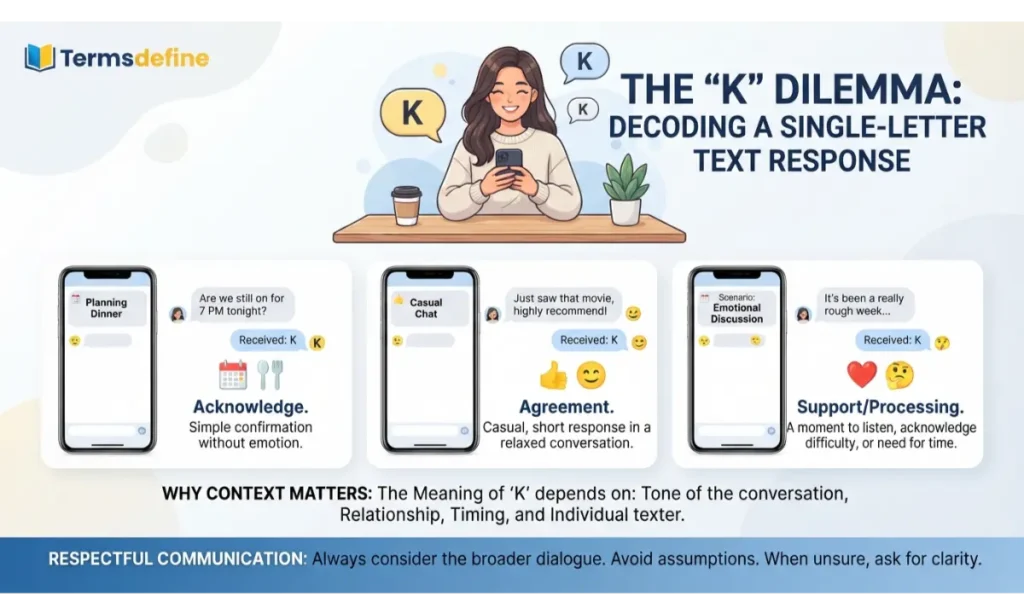
The confusion comes from tone. A single K can feel perfectly normal between people who regularly text that way, but it can also seem cold, distant, annoyed, or dismissive when the conversation is emotional. The surrounding words, punctuation, relationship, and usual texting habits all matter.
You may see K in text messages, group chats, social media DMs, gaming conversations, and other informal digital spaces. This guide explains what K means, how it changes across situations, how to respond, and when a clearer alternative is better.
Quick Answer
K usually means “okay” in text messages and online chats. It can show agreement, understanding, or simple acknowledgment, but depending on context, a one-letter K may also sound brief, cold, or dismissive.
What Does K Meaning in Text?
The most common K meaning in text is simply “okay” or “OK.” It is a very short response used when someone wants to acknowledge information without typing the complete word.
For example:
Person A: “I’ll call you after work.”
Person B: “K”
Here, K probably means, “Okay, I understand.”
It can also communicate agreement:
Person A: “Let’s meet at 7.”
Person B: “K”
There is no hidden meaning required. The person may simply be confirming the plan.
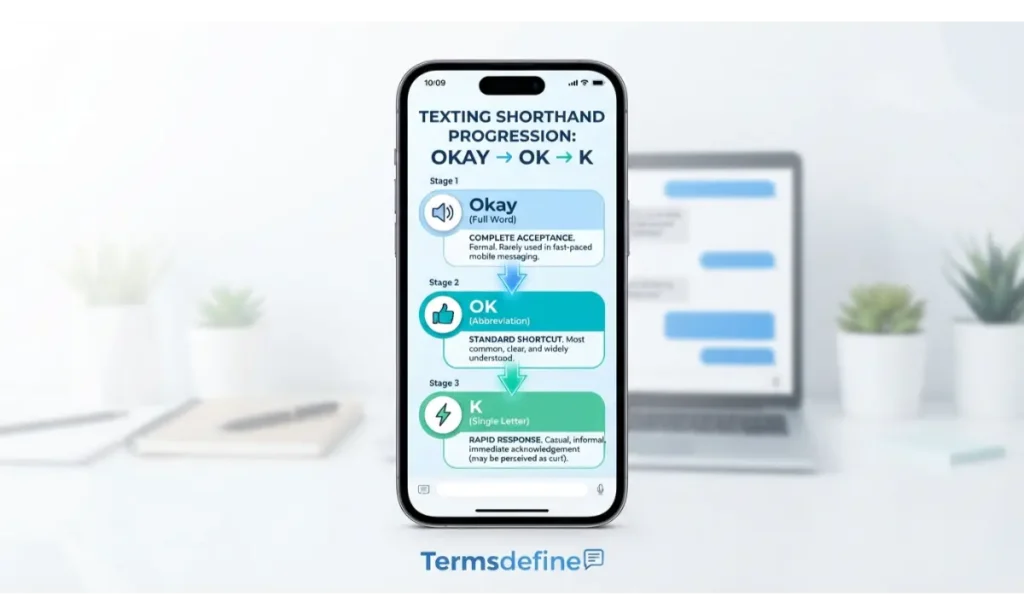
Is K Short for Okay?
Yes. In texting, K is generally a shortened form of OK or okay, rather than an acronym made from several words. Wiktionary specifically lists K as colloquial text-messaging and Internet slang for “OK.”
Think of the progression as:
Okay → OK → K
However, the shorter form can carry a different social feeling. Writing “Okay, sounds good!” provides more emotional information than simply writing “K.”
That difference does not mean K is automatically rude. It means the reader has fewer clues about the sender’s attitude.
K Meaning in Social Media
On social media, K usually retains its basic meaning of “okay,” “got it,” or “I understand.” You may encounter it in comments, direct messages, replies, and group conversations.
For example:
“I’ll send you the link later.”
“K.”
The exact platform usually does not create a completely different slang definition. Instead, the surrounding conversation determines how the response feels.
One important exception is when K appears with a number, such as 10K followers. In that context, K commonly represents thousand, not “okay.” That is a different use of the letter and should not be confused with the texting abbreviation.
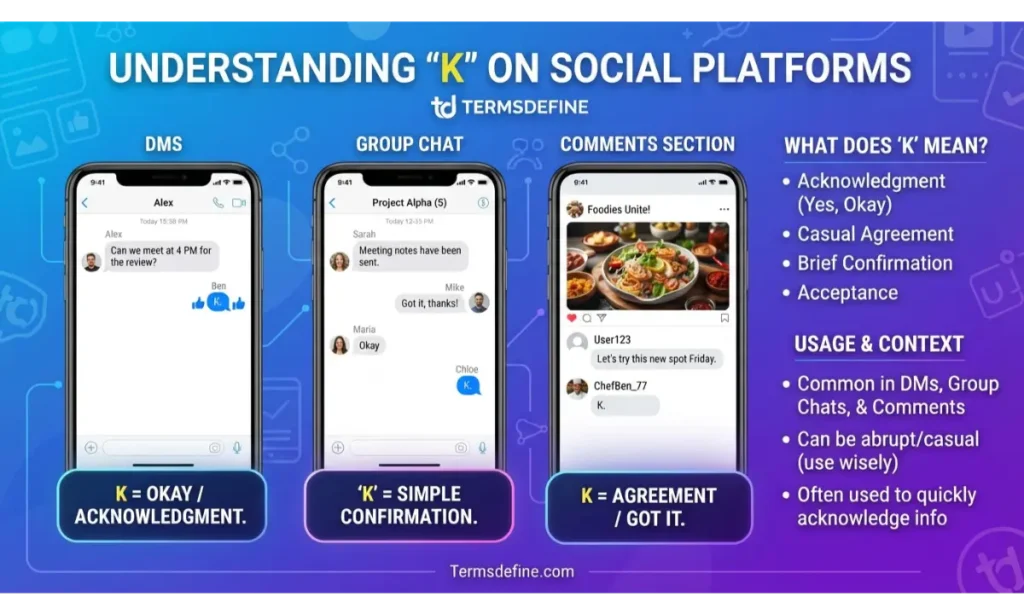
How K Is Used on WhatsApp, Instagram, and TikTok
You can see K across many messaging and social platforms, including WhatsApp, Instagram, TikTok, Snapchat, Facebook Messenger, and ordinary SMS.
Its basic texting meaning remains similar:
- WhatsApp: quick acknowledgment
- Instagram DMs: brief response or agreement
- Snapchat: fast casual reply
- TikTok: possible short comment or DM response
- Group chats: confirmation of information
- Gaming chats: quick acknowledgment when speed matters
The platform alone does not tell you whether K is friendly or annoyed. Look at the conversation before assigning an emotional meaning.
Why Can K Sound Rude?
A single K can sometimes feel rude because it provides almost no emotional information. Compare:
“Okay!”
“Okay 😊”
“Sounds good!”
“K”
The first three give the reader additional clues. K gives almost none.
This is especially noticeable after a long, emotional, or carefully written message. If someone explains a problem for several paragraphs and receives only “K,” the reply may feel dismissive even if the sender did not intend it that way.
Language researchers and commentators have noted that digital communication can make tiny changes in wording and punctuation carry extra social meaning.
What Does K Mean From a Girl?
There is no universal K meaning from a girl. A woman or girl sending K may simply be saying “okay,” especially if short replies are normal in her texting style.
Context is more useful than gender.
For example:
You: “I’ll pick you up at 8.”
Her: “K”
This could simply mean she received the information.
But:
You: “I’m sorry I canceled again. I understand why you’re upset.”
Her: “K”
That response may feel more distant because the conversation is emotional.
Do not assume that K has a special female meaning. Look at what happened before the message and how that person normally communicates.
What Does K Mean From a Guy?
The same principle applies when a guy sends K. It does not automatically mean he is angry, uninterested, or trying to end the conversation.
For example:
You: “The game starts at 9.”
Him: “K”
That is likely just acknowledgment.
On the other hand:
You: “Are we still arguing about this?”
Him: “K.”
The period and the serious context may make the response feel more final.
Gender does not provide a reliable decoding system. Individual communication habits and conversation context are much more useful.
K in Friendship and Casual Conversations
Among friends, K can be completely ordinary. Some people naturally prefer short replies, especially when they are busy, distracted, or already familiar with the person they are talking to.
Consider:
Friend: “Pizza at 8?”
You: “K”
There is little reason to interpret this negatively.
But if your friend normally writes long, enthusiastic messages and suddenly starts replying with one-word answers, the change in communication style may be worth noticing. Even then, K alone does not prove that something is wrong.
A person’s normal texting pattern provides important context.
K in Dating and Romantic Conversations
In dating conversations, K can attract more attention because people often look closely at short replies for emotional clues.
For example:
You: “I had a really nice time tonight.”
Them: “K”
That may feel strange because the response does not match the warmth of the original message.
However, it could also be a rushed reply, a misunderstanding, or simply that person’s normal texting style.
Instead of immediately assuming rejection or anger, look at the broader conversation. If clarity matters, ask directly rather than trying to decode one letter.
K Meaning After an Argument
After an argument, K can sound more serious than it would during an ordinary conversation.
For example:
You: “I understand your point. Let’s talk about it tomorrow.”
Them: “K.”
Here, the message might signal acceptance, reluctance, frustration, or simply that the person does not want to continue typing.
The important point is that K does not have one fixed emotional meaning. The conflict creates the possibility of a colder interpretation.
Do not treat the letter itself as proof of someone’s feelings.
How Punctuation Changes the Tone of K
Punctuation can influence how a short message is perceived.
Compare:
- K — brief and ambiguous
- K. — may feel more final or serious
- K! — can appear more energetic
- K 👍 — clearer acknowledgment
- kk — often feels more casual
- Okay! — usually gives more warmth or enthusiasm
These are communication tendencies, not strict rules. Different people use punctuation differently.
A person who normally writes “K.” may not intend irritation at all. Someone who never uses periods might make the same punctuation feel unusually formal or cold.
K vs. OK, Okay, Kk, and Sure
These replies can all communicate some form of agreement, but they do not always feel identical.
| Reply | Common meaning | Possible impression |
|---|---|---|
| K | Okay / got it | Very brief |
| OK | Okay | Direct and neutral |
| Okay | Agreement / acknowledgment | More complete |
| Kk | Okay / got it | Casual |
| Sure | Yes / agreement | Cooperative |
| Got it | I understand | Clear and explicit |
The difference is often less about dictionary meaning and more about the amount of social information in the message.
A useful rule is simple: if there is a chance your short reply could be misunderstood, add one or two words.
Real Texting Examples of K
Here are some natural examples:
Planning
A: “I’ll meet you outside at 6.”
B: “K”
Meaning: “Okay, understood.”
Group chat
A: “Everyone bring something to eat.”
B: “K”
Meaning: “Got it.”
Apology
A: “Sorry I forgot to call.”
B: “K”
Meaning could be “okay,” but the shortness may also feel distant.
Gaming
A: “Join the lobby when you’re ready.”
B: “K”
Meaning: “Okay, I’m coming.”
The same letter works differently because the surrounding situations are different.
How to Respond When Someone Says K
Your response should depend on whether the conversation actually requires another reply.
1 If K simply confirms a plan, you may not need to respond at all.
2 If you want to continue, try:
- “Sounds good.”
- “Thanks!”
- “See you then.”
- “Got it.”
- “Cool, talk later.”
3 If you are worried that K sounded upset, avoid immediately sending several messages asking, “Are you mad?” Instead, consider the whole conversation first.
4 If there is genuine uncertainty, a simple question such as “Everything okay?” can create clarity without turning one short reply into a larger issue.
Alternative Meanings of K
Although K meaning in text usually refers to “okay,” the letter K has many other meanings outside ordinary texting.
For example, K can represent thousand when used with numbers, such as 5K or 20K. In science, K is the symbol for kelvin, a unit of temperature. In chemistry, K represents potassium.
These meanings are not normally relevant when someone sends you a standalone K in a casual chat.
Context determines which interpretation makes sense. A message saying “K, see you later” is clearly different from “20K views.”
When Should You Avoid Using K?
K is best kept for casual communication where the other person is likely to understand your texting style.
Avoid relying on it in:
- Job applications
- Formal emails
- Academic writing
- Business reports
- Official documents
- Important customer communication
Instead, write “Okay,” “Understood,” “Thanks,” “Certainly,” or another clear response.
The problem is not that K is grammatically wrong in every situation. It is that its extreme brevity can create unnecessary ambiguity in settings where clarity matters.
What Is the Origin of K in Texting?
The exact origin of K as a texting abbreviation is not completely certain. Language references document K as Internet and text-message shorthand for “OK,” while historical online records show the abbreviation appearing in early-2000s Internet and texting culture.
The form became especially useful in environments where people wanted fast, compact communication, including SMS, online chat, and gaming.
By the 2000s and 2010s, K had also developed a cultural reputation for sounding unusually brief or dismissive. Contemporary discussions have highlighted how tiny differences between “K,” “OK,” “okay,” and “kk” can affect perceived tone.
The exact path by which the single letter became widespread should not be treated as a single proven invention story.
Common Misunderstandings About K
One common mistake is assuming K always means someone is angry. It does not.
Another is assuming that K always means “I don’t care.” That interpretation is possible in some contexts but is not the basic definition.
People also sometimes believe K has a special meaning when sent by a girl, guy, friend, or romantic partner. There is no reliable universal rule like that.
Finally, do not ignore someone’s normal communication style. If a person regularly sends one-letter replies, K may simply be their efficient way of texting.
Key Takeaways
- K Meaning in Text “okay” in texting and online chats.
- It can show acknowledgment, agreement, or understanding.
- Its emotional tone depends heavily on context and the sender’s usual texting style.
- K may feel cold or dismissive, especially during emotional conversations.
- Gender does not give K a fixed meaning.
- In other contexts, K can mean things such as thousand, kelvin, or potassium.
FAQs
What does K meaning in text?
K usually means “okay,” “got it,” or “I understand.” It is a very short form of OK or okay.
Is K rude in texting?
Not automatically. K can be completely neutral, but its brevity may make it sound cold or dismissive in certain conversations.
What does K mean from a girl?
It generally means the same thing as it does from anyone else: okay, understood, or acknowledged. The surrounding conversation determines the tone.
What does K mean from a guy?
Usually “okay” or “got it.” It does not automatically mean that he is angry, uninterested, or ending the relationship.
What does K mean in a relationship?
It can simply acknowledge a message, but during an emotional conversation it may feel distant or final. Context is essential.
How should I respond to K?
If the conversation is finished, you may not need to reply. Otherwise, “Sounds good,” “Got it,” or “Thanks!” are simple responses.
Is K formal or informal?
K is informal texting shorthand. Use clearer wording such as “Okay” or “Understood” in professional and formal communication.
Does K have other meanings?
Yes. Depending on context, K can represent “thousand,” kelvin, potassium, or other terms outside texting. Those meanings should be separated from the texting use.
Conclusion
The simplest K meaning in text is “okay.” It is commonly used as a quick acknowledgment, confirmation, or agreement. However, the single-letter reply can sometimes feel colder than “OK,” “Okay,” or “Sounds good,” particularly during emotional or serious conversations.
The safest way to understand K is to look beyond the letter itself. Consider the conversation, the relationship, punctuation, and the sender’s usual communication style. K does not automatically mean anger, rejection, or disinterest. In most casual chats, it simply means the person received your message and is acknowledging it.

My name is Tayyab Abbas, and I am the lead content author at TermsDefine.com. Holding a Master’s degree in English along with 5+ years of dedicated linguistic research experience, I focus on transforming complex terminology, word definitions, and technical jargon into clear, easy-to-understand explanations. Every entry, context guide, and meaning published on this platform is thoroughly researched, drafted, and verified by me to maintain the highest standards of accuracy and real-world clarity. My objective is to provide readers with an authoritative, dependable dictionary resource for all their vocabulary needs.
1 thought on “K Meaning in Text and Social Media: Explained Simply”