

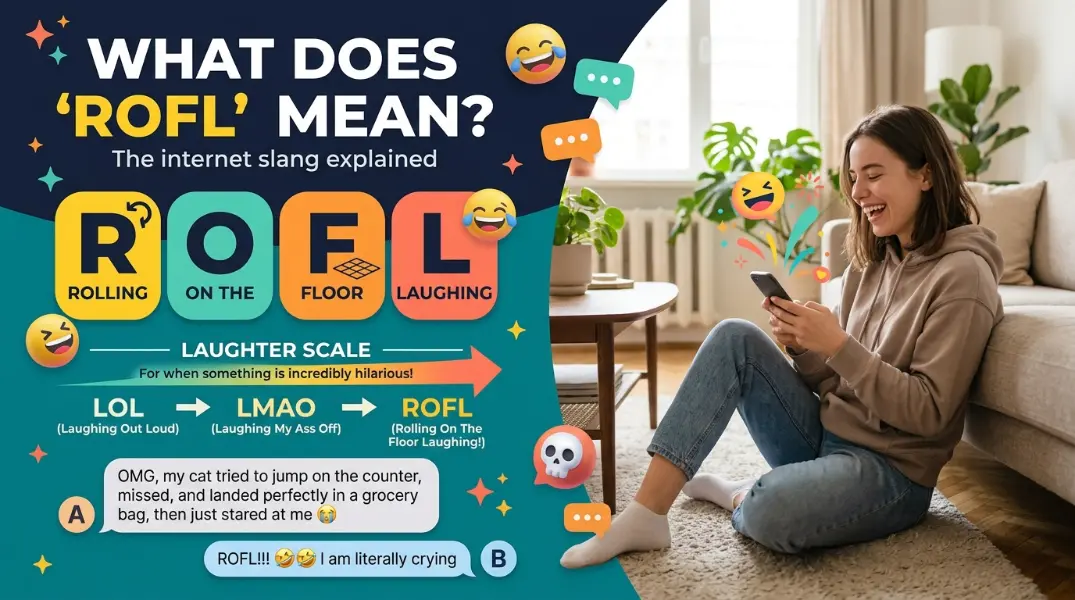
ROFL Meaning in Text “ROFL” in a text message, they are usually expressing strong laughter or saying that something is extremely funny.
This abbreviation is common in internet language and informal digital communication. Understanding it can help you follow jokes, memes, comments, and casual conversations more easily.
Quick Answer:
ROFL stands for “Rolling On the Floor Laughing.” People use it in texts, online chats, and social media comments to show that they find something very funny. It is an exaggerated expression of laughter, so the sender does not usually mean they are literally rolling on the floor.
What Does ROFL Stand For?
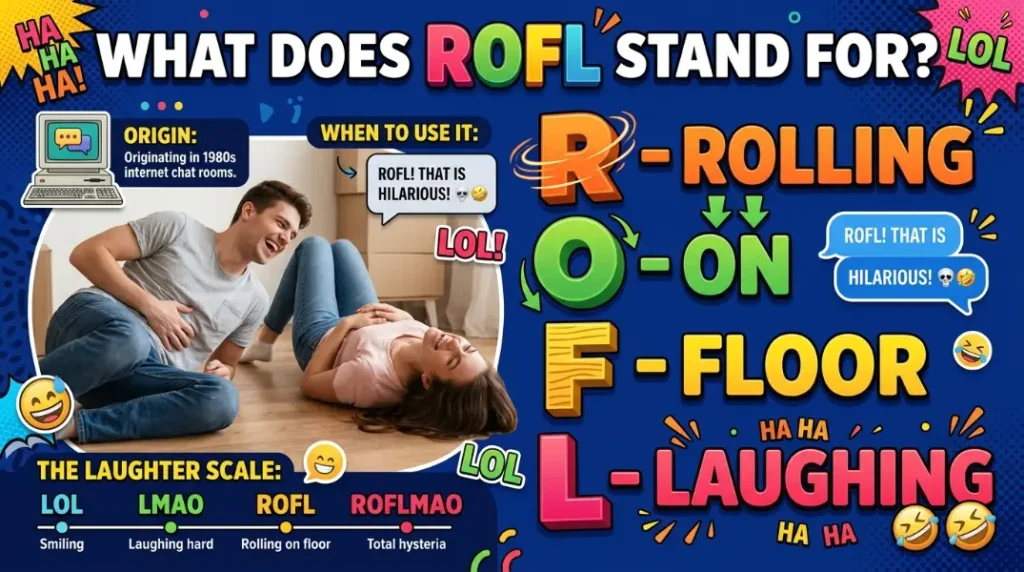
ROFL is an internet abbreviation that represents the phrase “Rolling On the Floor Laughing.”
Each letter contributes to the expression:
- R — Rolling
- O — On
- F — Floor
- L — Laughing
The phrase creates a funny mental image of someone laughing so hard that they fall to the floor and roll around. In everyday digital communication, it simply communicates intense amusement.
For example:
Friend 1: I walked into the wrong classroom and sat there for ten minutes.
Friend 2: ROFL 😂
Here, the second friend is laughing at the unexpected and embarrassing situation.
ROFL can appear in uppercase or lowercase. Both “ROFL” and “rofl” generally have the same meaning. Capital letters may make the response look more emphatic, but individual texting styles vary.
What Does ROFL Mean in Texting?
In texting, ROFL is a quick way to react to a funny message, an unexpected event, a joke, or an amusing story.
Instead of typing a long response such as “That is so funny,” someone can simply send ROFL. It keeps the conversation casual and communicates amusement with very few characters.
Here are some common ways people use it.
Reacting to a funny joke
When someone tells a joke that makes you laugh, ROFL can express a strong reaction.
Example:
Alex: My dog barked at his own reflection for five minutes.
Sam: ROFL, he really thought he found an enemy.
The reply shows that Sam finds the situation amusing.
Responding to an embarrassing moment
ROFL can also appear when friends share harmless, funny mistakes.
Example:
Mia: I waved at someone who was waving at the person behind me.
Zara: ROFL, I’ve done that too!
In this conversation, the abbreviation communicates laughter in a friendly way.
Reacting to memes and videos
People may use ROFL in comments or private messages when sharing funny videos, memes, and screenshots.
For example:
- “This video is ROFL 😂”
- “ROFL, watch the ending!”
- “That meme had me ROFL.”
These messages communicate amusement without requiring a detailed explanation.
ROFL Meaning on Social Media
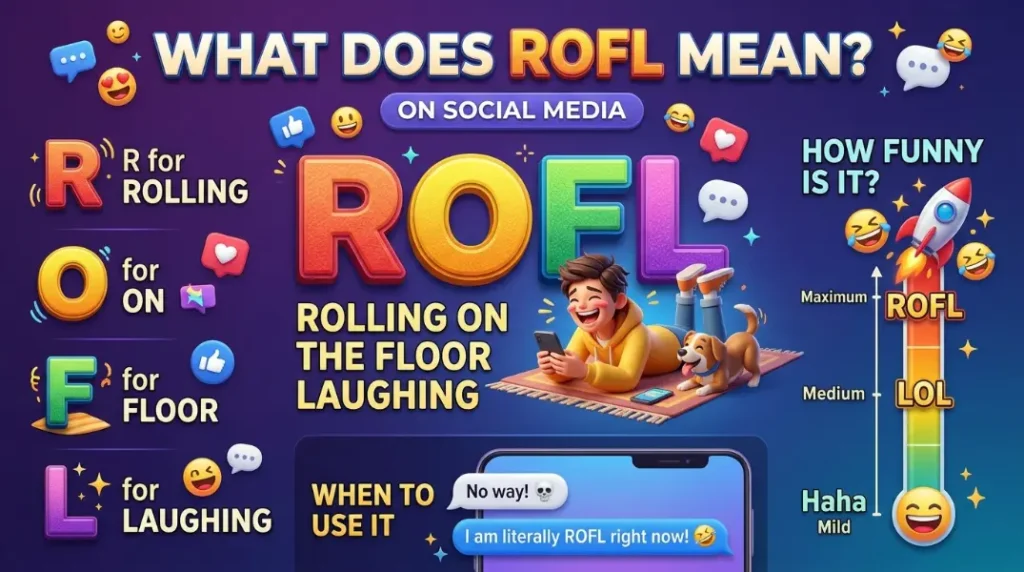
On social media, ROFL generally carries the same meaning as it does in text messages: “Rolling On the Floor Laughing.”
Someone might use it in a comment, a group discussion, a gaming chat, or a private message to react to humorous content.
For example:
- Instagram: “ROFL 😂 this caption is perfect.”
- TikTok: “ROFL, I wasn’t expecting that ending.”
- WhatsApp: “ROFL, you have to tell me what happened next.”
- Gaming chat: “ROFL, that was the funniest mistake ever.”
These are illustrative examples, not quotations from actual users.
The exact tone depends on the conversation. ROFL may communicate genuine laughter, playful teasing, or sarcasm. If someone is laughing at another person’s difficulty or embarrassment, it may sound unkind rather than friendly.
It is therefore helpful to consider the message around the abbreviation instead of interpreting it in isolation.
ROFL vs. LOL vs. LMAO
ROFL, LOL, and LMAO are all associated with laughter, but their wording and typical tone differ.
| Abbreviation | Full form | General meaning |
|---|---|---|
| ROFL | Rolling On the Floor Laughing | Strong or exaggerated laughter |
| LOL | Laughing Out Loud | Laughter or amusement |
| LMAO | Laughing My Ass Off | Strong laughter; informal and mildly vulgar |
ROFL paints a dramatic picture of someone laughing uncontrollably.
LOL is a shorter, flexible expression that can indicate amusement. Depending on the conversation, it may also soften a message or make it feel less serious.
LMAO expresses strong amusement in a more explicit, informal way. Because it includes mild profanity, it may be unsuitable for some professional or formal settings.
These expressions overlap, and there is no universal rule about which one represents the most laughter. Their meanings depend partly on the sender’s style and the context.
How to Use ROFL in a Sentence
ROFL is most suitable for informal communication with friends, family members, and people who understand internet slang.
Here are five natural examples:
- “ROFL, I can’t believe you actually said that.”
- “That video had me ROFL for five minutes.”
- “ROFL 😂 your reaction was even funnier than the joke.”
- “I read your message during class and almost started laughing. ROFL!”
- “ROFL, that was the most unexpected ending ever.”
The abbreviation can stand alone as a reaction or appear alongside other words and emojis.
However, it is not usually appropriate for formal reports, academic assignments, business proposals, or official emails. In those situations, expressions such as “That is very funny” or “That was amusing” may be more suitable.
How Should You Reply When Someone Says ROFL?
Your response depends on what the other person is laughing about and whether you want to continue the joke.
Here are some simple replies:
- “LOL 😂” — when you also find it funny.
- “I knew you’d laugh!” — when you expected that reaction.
- “Wait until you hear the rest.” — when you have another funny detail to share.
- “Glad you enjoyed it!” — when you are responding to their reaction.
- “It was even funnier in person.” — when you are describing a real event.
You do not need to reply with another abbreviation every time. A natural response that fits the conversation is usually best.
Is ROFL Formal or Informal?
ROFL is an informal internet expression. It works well in casual conversations but is generally not suitable for professional or academic writing.
Use it when chatting with friends, sharing memes, commenting on funny videos, or participating in relaxed online discussions.
Avoid it in formal situations where clarity and a professional tone matter. For example, instead of writing “ROFL, that presentation was funny” in a business email, you could say, “That was a very amusing presentation.”
Also, remember that humor is subjective. If the joke concerns someone’s serious problem or personal embarrassment, replying with ROFL may seem insensitive.
Key Takeaways
- ROFL stands for “Rolling On the Floor Laughing.”
- It expresses strong or exaggerated amusement in digital communication.
- People use it in text messages, online chats, and social media comments.
- ROFL is related to LOL and LMAO, but their wording and tone differ.
- It is informal, so use it where casual language is appropriate.
Frequently Asked Questions
What does ROFL mean from a girl or a boy?
ROFL has the same basic meaning regardless of who sends it. It usually means the person finds something very funny. The abbreviation alone does not establish romantic interest, flirting, or any particular intention.
Does ROFL mean someone is literally rolling on the floor?
No. In ordinary texting, ROFL is a figurative expression. It exaggerates the idea of laughing so hard that someone rolls on the floor.
What is the difference between ROFL and ROTFL?
Both abbreviations mean “Rolling On the Floor Laughing.” ROTFL includes the letter T for “the,” while ROFL leaves it out.
Can ROFL be sarcastic?
Yes. Although ROFL often communicates genuine amusement, it can be used sarcastically or mockingly. The surrounding message and relationship between the people help determine the intended tone.
Is ROFL still understandable today?
ROFL remains a recognizable internet abbreviation, although people’s preferred expressions vary. Some may use LOL, laughter emojis, or other informal reactions instead. It is best not to assume that everyone uses the same slang.
Conclusion
ROFL means “Rolling On the Floor Laughing” and is used to show that something is extremely funny. You may see it in text messages, social media comments, gaming chats, and other informal conversations.
Although it is related to LOL and LMAO, each expression has its own wording and tone. When you see ROFL, consider the surrounding conversation to understand whether the sender is genuinely amused, joking, or being sarcastic.

My name is Tayyab Abbas, and I am the lead content author at TermsDefine.com. Holding a Master’s degree in English along with 5+ years of dedicated linguistic research experience, I focus on transforming complex terminology, word definitions, and technical jargon into clear, easy-to-understand explanations. Every entry, context guide, and meaning published on this platform is thoroughly researched, drafted, and verified by me to maintain the highest standards of accuracy and real-world clarity. My objective is to provide readers with an authoritative, dependable dictionary resource for all their vocabulary needs.