

FAFO Meaning in Text“FAFO” in a text message, meme, or social media comment? This abbreviation can be confusing if you have never encountered it before. It is an informal expression about taking risks, pushing boundaries, and facing the consequences.
Quick Answer
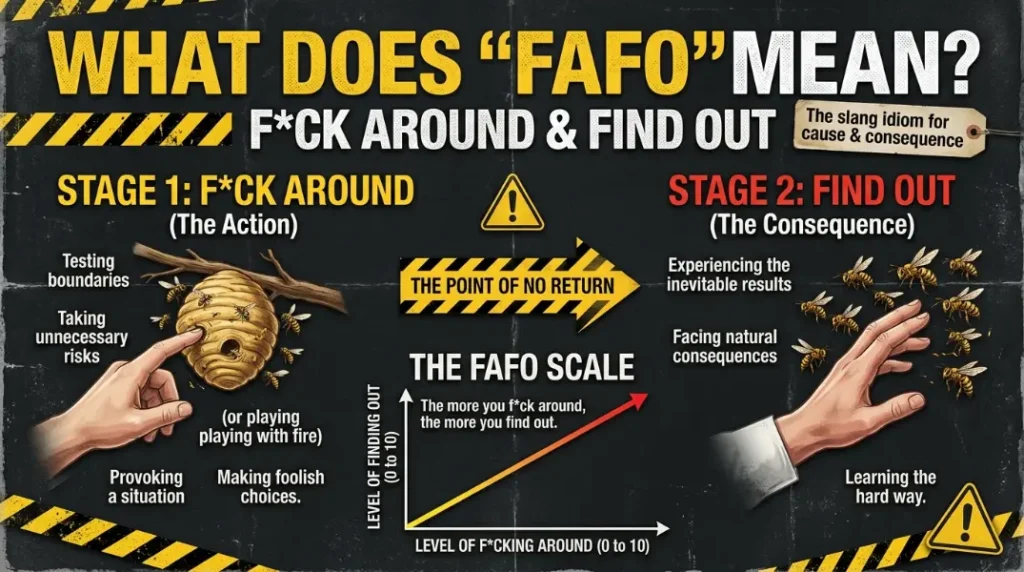
FAFO stands for “Fuck Around and Find Out.” In texting, it means that someone may experience the consequences of their actions, especially after ignoring a warning or taking an unnecessary risk. It can sound playful, sarcastic, challenging, or threatening, depending on the situation.
What Does FAFO Stand For?
FAFO is an acronym formed from the first letters of the phrase “Fuck Around and Find Out.” It is considered vulgar internet slang because its full form contains profanity. Dictionary.com identifies it as an expression used to warn or challenge someone when unwanted consequences may follow their behavior.
In simple English, FAFO communicates the idea that actions have consequences. Someone who ignores advice, provokes another person, or takes a risky action may eventually discover what happens.
For example:
Friend 1: “I’m going to keep teasing him even though he told me to stop.”
Friend 2: “FAFO.”
In this conversation, the second friend is warning that continuing to tease someone could lead to an unpleasant outcome.
People sometimes replace the profanity with a softer word, such as “fool,” when explaining the expression to a more general audience. However, the established slang expansion uses the F-word.
What Does FAFO Mean in Text Messages?
When someone sends FAFO in a text, they usually want to make a point about consequences without writing a long explanation.
Depending on the conversation, it may communicate several related ideas:
- A warning: Continuing the behavior could get you into trouble.
- A challenge: Go ahead and see what happens.
- A sarcastic reaction: You ignored the warning, and now you are facing the result.
- A playful comment: You are taking a silly risk, so let’s see how it turns out.
Consider this example:
Alex: “I’m going to stay up all night even though I have an exam tomorrow.”
Sam: “FAFO 😂”
Here, Sam is probably joking about Alex’s decision and the possible consequences of losing sleep.
Now consider a different situation:
Alex: “He told me to leave him alone, but I’m going to keep messaging him.”
Sam: “You’re going to FAFO.”
This sounds more serious because it warns Alex that ignoring someone’s boundaries may lead to consequences.
The abbreviation itself does not reveal the sender’s exact intention. The surrounding messages and the relationship between the people help determine the tone.
FAFO Meaning on Social Media
FAFO also appears in social media posts, memes, comment sections, and online discussions. People may use it to react to someone’s decision or describe a situation in which a person faces the results of their own actions.
For example:
- In a meme: Someone ignores a warning and immediately makes a mistake. A commenter writes, “FAFO.”
- In a discussion: A person deliberately provokes others and receives a strong response. Someone comments, “They wanted to FAFO.”
- In a funny video: A person attempts a risky stunt and fails. A viewer writes, “Well, FAFO 😂.”
In these examples, the expression highlights cause and effect. It can also suggest that the outcome was predictable or that the person should have listened to earlier warnings.
The meaning does not fundamentally change from one social media platform to another. What matters most is the situation being discussed.
Examples of FAFO in Everyday Conversations
The following original examples show how people might use FAFO in casual messages.
1. Between Friends
Mia: “I’m going to eat this extremely spicy pepper.”
Liam: “FAFO 😂”
Meaning: Liam is jokingly suggesting that Mia will discover the consequences of her decision.
2. After Ignoring Advice
Sara: “I told him not to drive so fast, but he wouldn’t listen.”
Emma: “FAFO. He should have listened.”
Meaning: Emma believes he is facing the consequences of ignoring a warning.
3. In a Group Chat
Noah: “Jake keeps changing the rules of our game.”
Ryan: “Let him FAFO.”
Meaning: Ryan suggests allowing Jake to experience the results of his behavior.
4. In an Online Comment
User 1: “She ignored every warning and went ahead anyway.”
User 2: “FAFO.”
Meaning: The commenter believes the outcome resulted from her decision.
5. During an Argument
Person A: “Keep spreading rumors about me.”
Person B: “FAFO.”
Meaning: This can sound confrontational or threatening because it suggests that consequences may follow.
These examples illustrate why context is important. The same abbreviation can be humorous among friends or intimidating during a disagreement.
Is FAFO Rude or Offensive?
Yes, FAFO can be considered rude because its full form contains a swear word. Even when someone writes only the four letters, readers familiar with the expression generally understand its meaning.
However, the level of offensiveness depends on the situation.
- Among close friends: It may be accepted as casual humor.
- In an online comment: It may express sarcasm, criticism, or approval of consequences.
- During a disagreement: It can sound aggressive or threatening.
- At work or school: It may be inappropriate because of its profanity and confrontational tone.
It is best to avoid FAFO in formal emails, job applications, professional conversations, and other situations where respectful language is expected.
More appropriate alternatives include “actions have consequences,” “you were warned,” and “you may regret that decision.”
How Should You Respond to FAFO?
Your response should depend on how the other person uses the expression.
If a friend uses FAFO jokingly, you might respond with humor. If the message seems serious, it is better to avoid escalating the disagreement.
Here are a few possible replies:
- “Haha, we’ll see!” — A playful response to a friendly challenge.
- “Fair enough.” — A calm acknowledgment.
- “I know the risks.” — A response when you understand the possible consequences.
- “What do you mean by that?” — A useful question when the message is unclear.
- “Let’s keep this respectful.” — An option when the conversation becomes confrontational.
If someone sends FAFO along with aggressive language or other threatening messages, consider the wider context rather than assuming it is harmless slang.
FAFO vs. Similar Expressions
FAFO is related to several English expressions, but each has a slightly different tone.
| Expression | Meaning | Typical tone |
|---|---|---|
| FAFO | Take a risk and discover the consequences | Blunt, challenging, or humorous |
| Actions have consequences | What you do can affect what happens next | Neutral or serious |
| You were warned | Someone gave advance notice of a possible outcome | Direct |
| Don’t push your luck | Stop before your situation gets worse | Cautionary |
| Play stupid games, win stupid prizes | Reckless or foolish behavior can lead to undesirable results | Sarcastic |
These expressions can communicate similar ideas, but FAFO is more vulgar and may sound more confrontational than the alternatives.
Key Takeaways
- FAFO stands for “Fuck Around and Find Out.”
- It refers to experiencing the consequences of your actions.
- It can be used as a warning, challenge, joke, or sarcastic reaction.
- Its tone depends on the conversation and the relationship between the speakers.
- Because it contains profanity, it is generally better suited to informal communication than professional settings.
Frequently Asked Questions
What does FAFO mean in text?
FAFO means “Fuck Around and Find Out.” It suggests that someone will discover the consequences of their actions, especially after taking a risk or ignoring a warning.
What does FAFO mean in slang?
In slang, FAFO is a blunt expression about cause and effect. It can warn someone about possible consequences or describe a situation in which someone gets the result of their own actions.
Does FAFO always mean a threat?
No. FAFO can be playful or sarcastic among friends. However, when directed at someone during a heated argument, it can sound like a threat. Context matters.
Is FAFO appropriate for formal messages?
Generally, no. Its full form contains profanity, and it can sound confrontational. In professional communication, “actions have consequences” is a more suitable alternative.
What is a polite alternative to FAFO?
You can say “actions have consequences,” “you may find out the hard way,” or “don’t push your luck.” These alternatives communicate a similar idea without using the same profanity.
Conclusion
FAFO means “Fuck Around and Find Out,” an informal expression used when someone takes a risk, ignores a warning, or faces the consequences of their behavior. You may encounter it in text messages, social media comments, memes, and casual conversations.
Remember that FAFO can be funny, sarcastic, or confrontational depending on the situation. Understanding the surrounding conversation will help you interpret its meaning more accurately and decide whether it is appropriate to use.
