

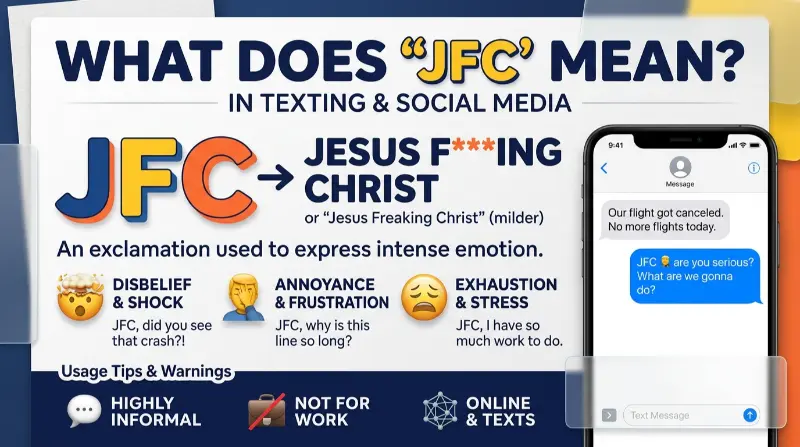
Have you received a message containing “JFC” and wondered what it means?
This abbreviation appears in casual text messages, online conversations, and social media comments.
Understanding its full meaning can help you interpret the sender’s reaction and avoid using it in the wrong situation.
Quick Answer: What Does JFC Mean in Text?
JFC stands for “Jesus fucking Christ.” It is a vulgar slang expression used to show shock, frustration, disbelief, annoyance, or surprise. The exact emotion depends on the conversation, and the expression may offend people who consider its religious reference disrespectful.
What Does JFC Stand For?
JFC is an initialism formed from the first letters of the words in “Jesus fucking Christ.” People generally pronounce the letters individually rather than saying the full phrase.
In informal communication, it works as a strong emotional reaction. Someone might type it after receiving unexpected news, seeing an unbelievable price, experiencing a frustrating problem, or watching something surprising happen.
For example:
Friend A: The concert tickets cost $400 each.
Friend B: JFC, that’s expensive!
Here, JFC emphasizes the speaker’s surprise and disbelief about the price.
Although the phrase contains a religious reference, it is generally used as an exclamation rather than as a literal religious statement in casual online conversations.
How Is JFC Used in Texting?
JFC can appear at the beginning of a message, in the middle of a sentence, or on its own. Its meaning becomes clearer when you consider what happened before the message.
Common uses include the following.
1. To Express Shock or Surprise
People may use JFC when something unexpected happens.
Example:
Person A: I just found out we have an exam tomorrow.
Person B: JFC, nobody told me!
The sender is surprised by the unexpected news.
2. To Show Frustration or Annoyance
JFC can express irritation when a situation becomes difficult or repetitive.
Example:
Person A: The internet has stopped working again.
Person B: JFC, this is the third time today.
In this conversation, the abbreviation communicates frustration rather than simple surprise.
3. To Express Disbelief
Someone may use JFC when they find a story, statement, or event hard to believe.
Example:
Person A: He forgot his own birthday.
Person B: JFC, how did that happen?
The sender is reacting with disbelief.
4. To React to Something Funny or Ridiculous
Depending on the relationship and surrounding messages, JFC can also accompany humorous or exaggerated reactions.
Example:
Person A: I walked into the wrong classroom and sat there for 20 minutes.
Person B: JFC 😂
The laughing emoji suggests that the sender finds the situation amusing or unbelievable.
These examples are illustrative, not quotations from actual conversations.
What Does JFC Mean on Social Media?
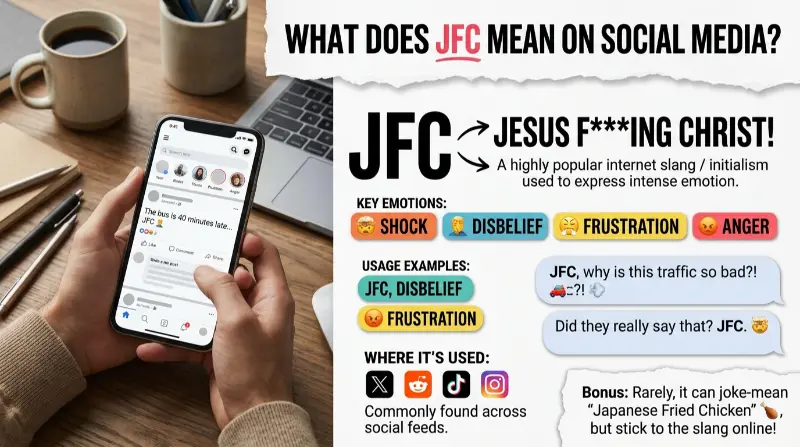
On social media, JFC has essentially the same slang meaning as it does in text messages. It can appear in comments, replies, private messages, memes, and online discussions.
For example:
- Instagram: “JFC, that sunset is beautiful!” — expresses strong amazement.
- TikTok: “JFC, that ending was unexpected.” — expresses surprise.
- Reddit: “JFC, why would anyone do that?” — may communicate disbelief or annoyance.
- Group chat: “JFC, I nearly missed my train.” — expresses shock or relief after a stressful moment.
These are examples of possible usage, not separate platform-specific definitions.
The surrounding conversation is important. A comment containing JFC might be playful among friends but sound angry or aggressive in a serious discussion.
Is JFC Rude or Offensive?
Yes, JFC is generally considered vulgar because it stands for a phrase containing profanity and a religious reference. Some people use it casually, while others may find it offensive or disrespectful.
Whether it is appropriate depends on the audience and situation.
| Situation | Is JFC appropriate? |
|---|---|
| Private chat with close friends | Depends on everyone’s comfort level |
| Casual online comments | Commonly encountered, but still vulgar |
| Family group chat | Consider whether others may be offended |
| Professional messages | Best avoided |
| Academic or formal writing | Inappropriate in most contexts |
If you want to express the same reaction without profanity, consider these alternatives:
- OMG: Shows surprise or amazement.
- Wow: A neutral way to express a strong reaction.
- Seriously? Expresses disbelief or annoyance.
- Oh my goodness: A more polite expression of surprise.
- That’s unbelievable: Communicates shock or disbelief clearly.
These alternatives may convey a similar reaction without the same vulgar wording.
How Should You Reply to JFC?
You do not need to respond to JFC in a particular way. Your reply should match the conversation and the emotion the sender appears to express.
Here are a few examples.
If the sender is surprised:
Friend: JFC, the price of everything has gone up!
You: I know, it’s getting expensive.
If the sender is frustrated:
Friend: JFC, my computer crashed again.
You: That’s frustrating. Did you save your work?
If the sender is joking:
Friend: JFC 😂 I can’t believe you did that.
You: I know, it was a ridiculous decision!
If you’re unsure what they mean:
You: Wait, are you surprised or annoyed?
If the message seems hostile, you can ask for clarification rather than assuming the sender is angry with you. The abbreviation alone does not reveal the person’s exact intention.
Are There Other Meanings of JFC?
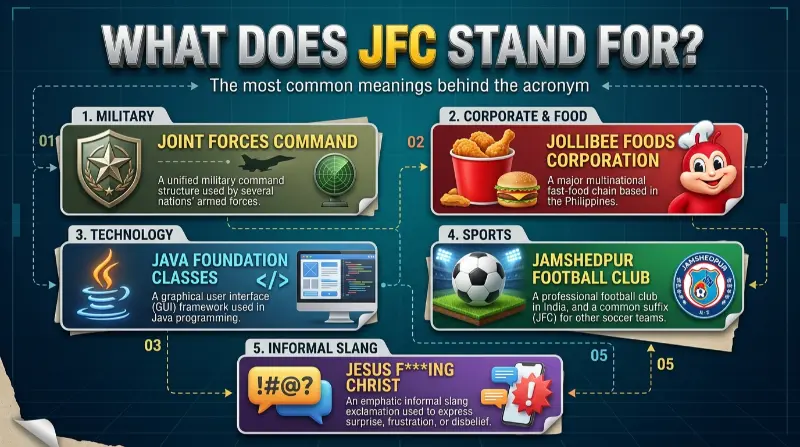
Yes. Outside informal texting, JFC can refer to unrelated technical or organizational terms.
For example, in computing, JFC can stand for Java Foundation Classes, a collection of Java technologies used to build graphical user interfaces.
The correct interpretation depends on the setting:
- In a casual message such as “JFC, that was close,” it likely expresses a strong emotional reaction.
- In a Java programming discussion, JFC may refer to Java Foundation Classes.
- In business or organizational documents, it may be an abbreviation specific to that organization.
If you encounter JFC in a technical document, do not automatically assume it is slang.
Key Takeaways
- JFC usually means “Jesus fucking Christ” in texting and internet slang.
- It can express shock, surprise, frustration, disbelief, or annoyance.
- The sender’s tone depends on the surrounding conversation and any emojis or punctuation.
- JFC is vulgar and may offend some readers, so avoid it in formal or professional communication.
- In technical contexts, JFC can have unrelated meanings, including Java Foundation Classes.
Frequently Asked Questions
1. What does JFC mean in a text message?
JFC usually stands for “Jesus fucking Christ.” It is an informal, vulgar expression used to emphasize a strong reaction, such as shock, disbelief, or frustration.
2. Does JFC mean someone is angry?
Not necessarily. It can express anger or annoyance, but it can also communicate surprise, amazement, or amused disbelief. Read the rest of the message before deciding how the sender feels.
3. Is JFC the same as OMG?
They can serve similar purposes because both express strong reactions. However, JFC is generally more vulgar and potentially offensive than OMG, which usually stands for “oh my God.”
4. Can I use JFC at work?
It is best to avoid JFC in professional emails, workplace chats, and official documents. Words such as “seriously,” “unbelievable,” or “that’s frustrating” are safer alternatives.
5. What does JFC mean in online comments?
In online comments, JFC generally has the same meaning as in texting. It may express shock, disbelief, annoyance, or amazement, depending on what the person is responding to.
Conclusion
JFC usually stands for “Jesus fucking Christ” and is used in texting and online conversations to express strong emotions, including surprise, frustration, and disbelief. Because it contains profanity and a religious reference, it is not suitable for every audience. When you encounter JFC, consider the surrounding conversation to understand the sender’s intended tone.

My name is Tayyab Abbas, and I am the lead content author at TermsDefine.com. Holding a Master’s degree in English along with 5+ years of dedicated linguistic research experience, I focus on transforming complex terminology, word definitions, and technical jargon into clear, easy-to-understand explanations. Every entry, context guide, and meaning published on this platform is thoroughly researched, drafted, and verified by me to maintain the highest standards of accuracy and real-world clarity. My objective is to provide readers with an authoritative, dependable dictionary resource for all their vocabulary needs.