

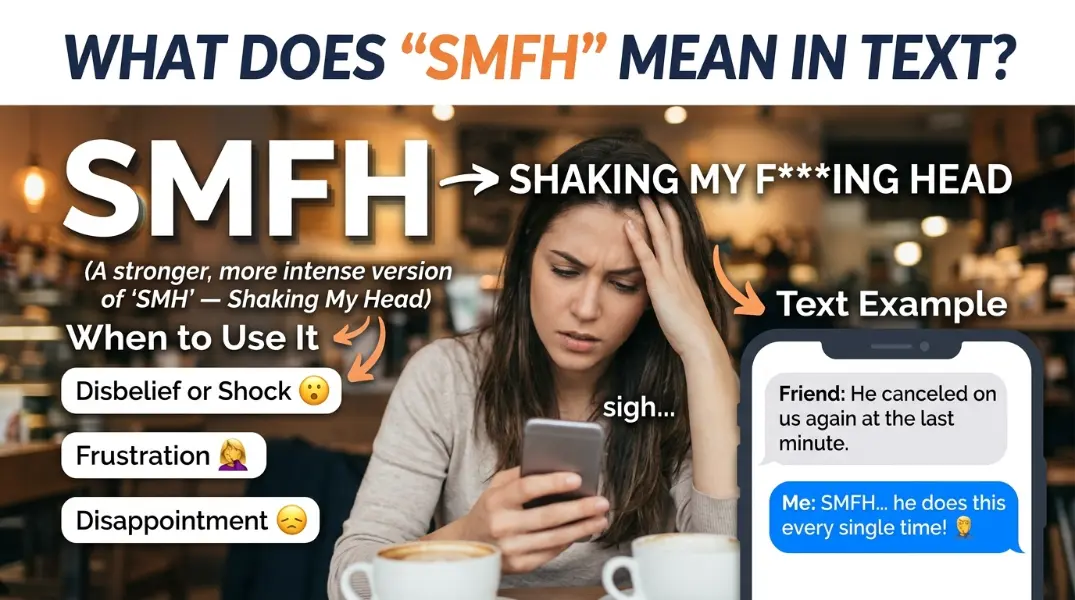
SMFH Meaning in Text “SMFH” and wondered what it meant? This abbreviation is used in informal digital communication to express frustration, disbelief, annoyance, or disappointment. You may see it in text messages, group chats, and social media comments.
Understanding the meaning of SMFH can help you recognize the emotion behind a message and decide how to respond appropriately.
Quick Answer: What Does SMFH Mean in Text?
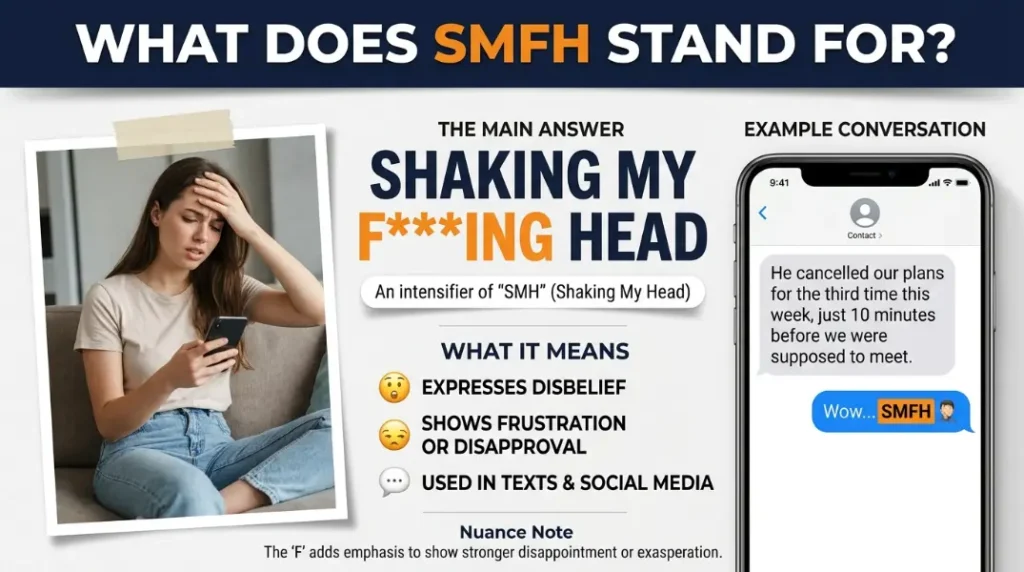
SMFH stands for “Shaking My Fing Head.”* It is an informal slang abbreviation used to show strong frustration, disbelief, or disappointment about something someone said or did. It is a stronger, more profane version of SMH, which means “Shaking My Head.”
Example:
Friend: “I forgot my homework again.”
You: “SMFH, you need to start checking your bag!”
In this conversation, SMFH expresses frustration or disbelief about the repeated mistake.
What Does SMFH Stand For?
SMFH represents four words:
- S — Shaking
- M — My
- F — Fing*
- H — Head
The phrase describes the familiar reaction of shaking your head when something seems ridiculous, disappointing, or difficult to believe.
The added F-word makes the expression stronger than the abbreviation SMH. Because it contains profanity, SMFH is best suited to casual conversations with people who are comfortable with that language.
Some people interpret the F as “freaking” to make the phrase less offensive. However, the established slang expansion uses the stronger swear word.
What Does SMFH Mean in Texting and Chat?
In texting, SMFH is usually a reaction to something frustrating, unbelievable, or disappointing. Instead of explaining every emotion in a complete sentence, someone can use these four letters to communicate their response quickly.
Here are some common situations in which people might use it.
1. Expressing Frustration
Someone might use SMFH when a problem happens repeatedly or when a person makes the same mistake again.
Example:
Person A: “The bus was late again, and I missed my class.”
Person B: “SMFH, that keeps happening to you.”
Here, the abbreviation shows frustration with the situation.
2. Showing Disbelief
SMFH can also communicate that something is hard to believe.
Example:
Person A: “He spent all his money on a game and forgot to pay his bill.”
Person B: “SMFH, seriously?”
The response suggests that the second person finds the decision unreasonable.
3. Expressing Disappointment
People may use SMFH when someone’s actions do not meet their expectations.
Example:
Friend A: “She promised to help but never showed up.”
Friend B: “SMFH, that’s disappointing.”
In this situation, SMFH expresses disapproval and disappointment.
4. Joking With Friends
Not every use of SMFH signals serious anger. Friends may use it playfully when someone does something silly.
Example:
Friend A: “I searched for my glasses for ten minutes. They were on my head.”
Friend B: “SMFH 😂”
The laughing emoji makes the response sound more humorous than hostile.
What Does SMFH Mean on Social Media?
SMFH generally carries the same meaning on social media as it does in private messages. Its interpretation depends on the post, comment, and conversation rather than the platform itself.
Someone might comment “SMFH” under a post about a frustrating situation, a questionable decision, or disappointing news.
Example: “They canceled the event at the last minute. SMFH.”
TikTok
The abbreviation can appear in comments reacting to an absurd, shocking, or frustrating moment in a video.
Example: “He really did that in public? SMFH.”
Snapchat and group chats
Friends may use SMFH to react to personal stories, repeated mistakes, or unexpected news.
Example: “I left my lunch at home again. SMFH.”
These are illustrative examples, not quotations from actual users. The abbreviation does not have a separate verified meaning on each of these platforms.
SMFH vs. SMH: What Is the Difference?
1SMFH and SMH communicate similar reactions, but their emotional intensity differs.
| Abbreviation | Full form | Typical tone |
|---|---|---|
| SMH | Shaking My Head | Mild disbelief or disapproval |
| SMFH | Shaking My F***ing Head | Stronger frustration or disbelief |
| SMDH | Shaking My Damn Head | Emphatic disbelief or frustration |
SMFH usually sounds more forceful because it includes profanity. SMH is a milder alternative that is generally suitable for a wider range of casual conversations.
Example of SMH:
“ You forgot your keys again? SMH.”
Example of SMFH:
“You forgot your keys again? SMFH!”
Both messages express disapproval, but the second may sound more irritated or emphatic. Punctuation and the relationship between the speakers can affect the tone.
Is SMFH Rude or Offensive?
SMFH can be considered rude or offensive because its standard expansion contains a swear word. Whether it sounds harsh depends on the people involved and the situation.
- With close friends: It may be playful or an ordinary expression of frustration.
- During an argument: It may sound judgmental, dismissive, or disrespectful.
- In public comments: It can come across as blunt criticism.
- At work or school: It is usually better to choose a more professional expression.
If you are unsure whether the other person is comfortable with profanity, choose a milder alternative.
For example, instead of writing “SMFH,” you could say “I can’t believe this,” “That’s really frustrating,” or “I’m disappointed.”
How Should You Reply When Someone Says SMFH?
Your response should depend on what the person is reacting to. You do not need to use slang yourself to keep the conversation natural.
Here are a few possible replies.
| Situation | Possible reply |
|---|---|
| You agree with their frustration | “I know, that’s ridiculous.” |
| They are sharing bad news | “That’s really frustrating. What happened?” |
| They are joking about a mistake | “😂 We all have those moments.” |
| You do not understand their reaction | “What happened?” |
| They seem genuinely upset | “I understand why you’re annoyed.” |
If the abbreviation is directed at something you did, consider the surrounding message before assuming the person is angry with you. They may be joking, expressing disappointment, or reacting to an unrelated situation.
When Should You Use SMFH?
SMFH works best in informal communication where the people involved understand internet slang and are comfortable with strong language.
It may be appropriate when:
- Chatting casually with friends.
- Reacting to an unbelievable situation.
- Expressing frustration in a private group chat.
- Making a joking comment about a harmless mistake.
Avoid using it in formal emails, professional messages, academic writing, or conversations where profanity could cause offense.
When you need a more neutral expression, use “I’m disappointed,” “That’s unbelievable,” or “I can’t believe that happened.”
Key Takeaways
- SMFH usually stands for “Shaking My F***ing Head.”
- It expresses strong frustration, disbelief, annoyance, or disappointment.
- It is more emphatic and profane than SMH.
- Its tone can be serious, playful, or critical depending on context.
- It is best reserved for informal conversations where strong language is acceptable.
Frequently Asked Questions
1. What does SMFH mean in text messages?
SMFH means “Shaking My F***ing Head.” People use it to react to something frustrating, disappointing, or difficult to believe.
2. What does SMFH stand for in slang?
In internet slang, SMFH stands for “Shaking My F***ing Head.” Some people use “freaking” as a milder alternative, but the standard expansion contains profanity.
3. Is SMFH stronger than SMH?
Yes. SMFH generally expresses a stronger reaction than SMH because of the added swear word. Both can communicate disbelief or disapproval.
4. Can SMFH be used jokingly?
Yes. Friends sometimes use SMFH to joke about silly mistakes or harmless situations. Emojis and the surrounding conversation can help communicate the intended tone.
5. Is SMFH appropriate for professional messages?
Usually not. Because its standard meaning includes profanity, it is safer to use alternatives such as “That’s disappointing” or “I can’t believe this” in professional communication.
6. What should I say instead of SMFH?
You can say “I can’t believe it,” “That’s frustrating,” “Seriously?” or “I’m disappointed.” These alternatives express similar feelings without relying on profanity.
Conclusion
The meaning of SMFH in text is “Shaking My Fing Head,”* an informal expression of strong frustration, disbelief, or disappointment. It is similar to SMH but carries a more forceful tone because of the profanity. Understanding the conversation and the relationship between the speakers will help you interpret it correctly and decide whether it is appropriate to use.

My name is Tayyab Abbas, and I am the lead content author at TermsDefine.com. Holding a Master’s degree in English along with 5+ years of dedicated linguistic research experience, I focus on transforming complex terminology, word definitions, and technical jargon into clear, easy-to-understand explanations. Every entry, context guide, and meaning published on this platform is thoroughly researched, drafted, and verified by me to maintain the highest standards of accuracy and real-world clarity. My objective is to provide readers with an authoritative, dependable dictionary resource for all their vocabulary needs.