


I first came across SYFM while looking through casual online conversations, and I quickly noticed how confusing four letters can become without context.
In my experience, people often use this abbreviation when they want someone to stop talking, stop complaining, or stay quiet.
SYFM means “Shut Your Fucking Mouth.” I use it as an example of strong internet slang because its tone is usually rude, aggressive, or insulting.
The phrase can appear during an argument, as an angry reaction, or sometimes among close friends who use harsh language jokingly.
When I explain SYFM to readers, I always point out that the meaning depends heavily on the relationship between the people involved. The same abbreviation can sound seriously offensive in one conversation and playful in another.
Quick Answer
- SYFM means “Shut Your Fucking Mouth,” a vulgar phrase telling someone to stop talking.
- I consider it highly informal and potentially offensive, so I recommend using it carefully, especially with people I do not know well.
What Does SYFM Mean?
When I see SYFM in a text message, I understand it as a shortened form of “Shut Your Fucking Mouth.” The speaker is usually telling another person to stop speaking, stop arguing, or stop making comments.
I see this abbreviation most often in heated online discussions, private messages, gaming chats, and social media conversations. Because it contains a profanity, I would not describe SYFM as polite or professional language.
The emotional force can vary from irritation to outright anger. In some conversations, the sender may use it to express frustration, while in others, friends may throw it around as a joke without intending serious hostility.
For me, the important point is that SYFM carries a strong attitude. Simply replacing the full phrase with four letters does not remove its offensive nature.
I would read the surrounding conversation before deciding how seriously the sender means it. Tone, relationship, punctuation, emojis, and the topic being discussed can all change how the abbreviation feels.
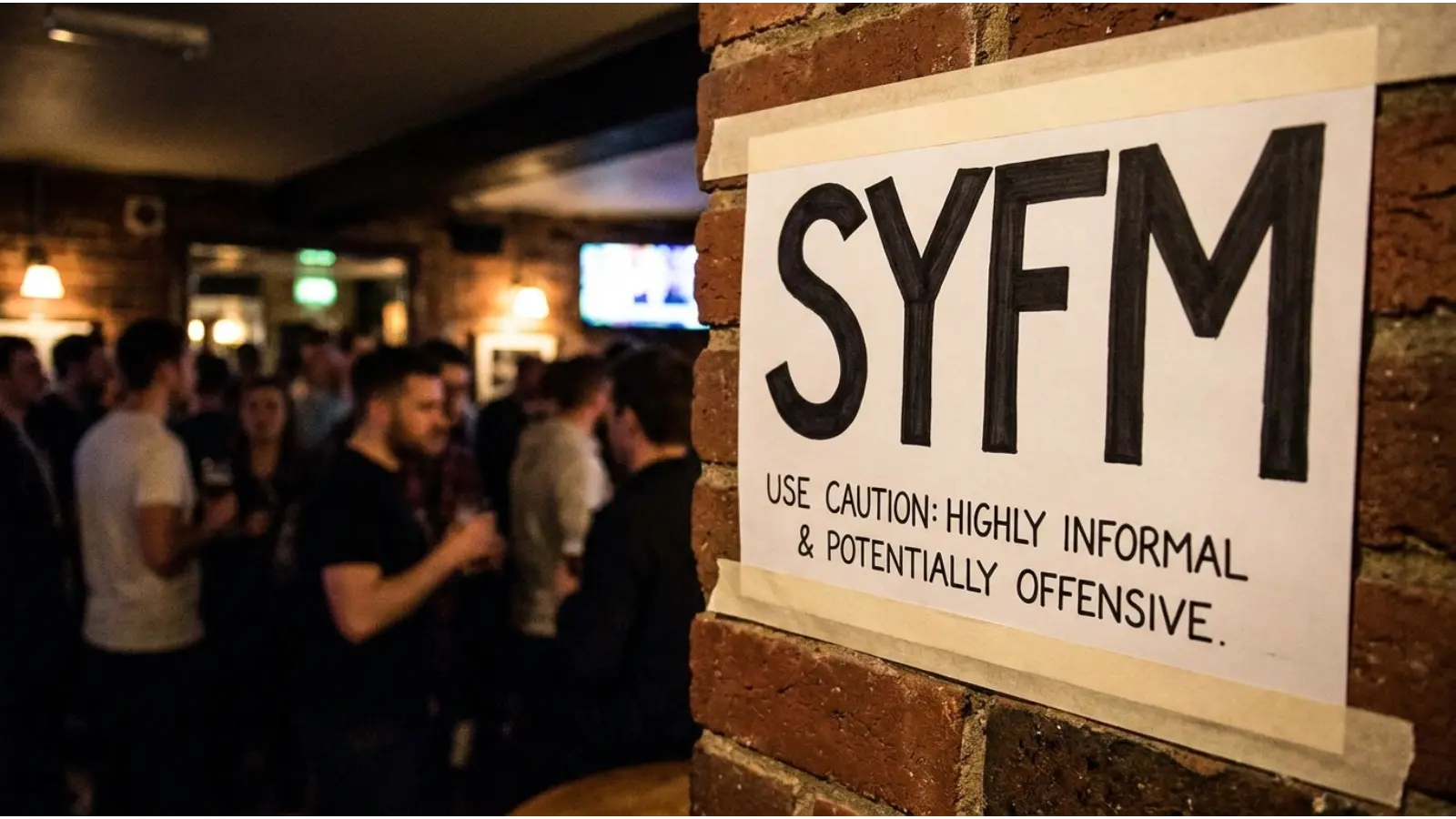
Origin and Nuance of SYFM
I view SYFM as an internet shorthand created from the first letters of the words in “Shut Your Fucking Mouth.” Like many texting abbreviations, it saves time by turning a longer phrase into a compact expression.
The phrase itself is much older than texting culture, but the abbreviation became useful as online messaging and fast digital communication grew. People could communicate an intense reaction without typing the entire sentence.
I also notice an important difference between SYFM and softer expressions such as “be quiet” or “please stop.” SYFM adds profanity, which gives the message a much harsher emotional impact.
Among close friends, I may see someone use SYFM jokingly after another person makes an exaggerated claim. In an argument, however, the same letters can feel confrontational and disrespectful.
This is why I would never judge the meaning from the abbreviation alone. I look at the relationship, conversation, and surrounding words before interpreting the sender’s intention.
How I See SYFM Used in Everyday Conversations
I usually find SYFM in informal communication rather than professional writing. Here are three situations that show how its meaning can change with the setting.
Conversational Example
If a friend keeps teasing me about something after I have asked them to stop, they might jokingly write:
“SYFM 😂 You are making this story worse.”
In this setting, the phrase can be playful if both people regularly use strong language with each other. I would still recognize the words as vulgar.
Formal Context
I would avoid SYFM completely in a workplace email, school assignment, customer message, or professional conversation. If I need someone to stop interrupting me, I would choose a respectful sentence such as “Please let me finish.”
Social Media Example
I may see someone comment:
“SYFM, nobody asked for your opinion.”
Here, I would interpret the abbreviation as hostile because the person is directly dismissing another user’s comment. The surrounding conversation can make the aggressive intention especially clear.
Common Misconceptions and Mistakes
One mistake I often see is assuming that SYFM is harmless simply because it is abbreviated. I would not make that assumption because shortening profanity does not remove the meaning or emotional force behind it.
Another common mistake is using SYFM with someone who does not know the sender well. A close friend might understand the expression as teasing, but a coworker, teacher, customer, or stranger could easily read it as an insult.
I also think readers should avoid confusing SYFM with softer phrases that simply ask someone to stop speaking. The presence of the F word makes the expression considerably stronger.
Some people may also interpret SYFM as playful sarcasm when the sender actually intends anger. I recommend examining the complete conversation instead of relying on the abbreviation by itself.
For my own writing, I would keep SYFM limited to casual conversations where strong language is already accepted. I would never treat it as a suitable replacement for polite communication.
How Should I Respond to SYFM?
When someone sends me SYFM, I first consider the situation instead of immediately reacting emotionally. If the person is clearly angry, I would avoid escalating the conversation with another insult.
A calm response such as “I understand you’re frustrated, but let’s talk respectfully” can change the direction of the exchange. If the message comes from a close friend and appears clearly playful, I might respond with humor instead.
If I do not know the sender well, I would treat the message more seriously. The safest approach can be to ask what they mean or simply stop engaging if the conversation has become abusive.
I also remind readers that they do not have to mirror someone’s language. Responding with another aggressive abbreviation can turn a small disagreement into a much larger argument.
For me, understanding SYFM is less about memorizing four letters and more about recognizing the attitude behind them.
Is SYFM Offensive?
Yes, I consider SYFM offensive in many situations because it represents a phrase containing profanity and directly tells another person to be silent. Its impact depends on the relationship, context, and intention of the people involved.
I might see friends use it jokingly without causing offense, but I would not assume everyone interprets it that way. In professional, academic, or unfamiliar settings, I would avoid it.
The phrase can also become particularly disrespectful when directed at someone during an argument. Even if the sender believes they are simply expressing frustration, the recipient may experience it as a personal attack.
For that reason, I recommend understanding the audience before using SYFM. Informal internet slang can be entertaining among friends, but the same wording can damage communication in a serious setting.
FAQs:
What Does SYFM Mean in Text?
SYFM stands for “Shut Your Fucking Mouth.” I use it to describe a vulgar and forceful way of telling someone to stop talking.
Is SYFM rude?
Yes, I consider SYFM rude because it contains profanity and can sound aggressive. Its impact can be softer among close friends who use strong language jokingly.
Can I use SYFM with friends?
I might use it with close friends only if I already know they are comfortable with that style of humor. I would avoid it with new friends, coworkers, teachers, customers, or strangers.
Is SYFM appropriate for work?
I would not use SYFM in professional communication. A polite request to stop speaking or interrupting is much safer and more respectful.
What should I say instead of SYFM?
I would choose phrases such as “Please stop,” “Please let me finish,” or “Can we talk calmly?” These alternatives communicate frustration without using profanity.
Final Thoughts
When I explain SYFM, I want readers to understand more than its four-letter abbreviation. For me, the key lesson is that SYFM means “Shut Your Fucking Mouth” and carries a strong, often offensive tone. Understanding that emotional weight helps me decide when casual slang fits and when respectful language is the better choice.

My name is Tayyab Abbas, and I am the lead content author at TermsDefine.com. Holding a Master’s degree in English along with 5+ years of dedicated linguistic research experience, I focus on transforming complex terminology, word definitions, and technical jargon into clear, easy-to-understand explanations. Every entry, context guide, and meaning published on this platform is thoroughly researched, drafted, and verified by me to maintain the highest standards of accuracy and real-world clarity. My objective is to provide readers with an authoritative, dependable dictionary resource for all their vocabulary needs.
4 thoughts on “What Does SYFM Mean in Text, Slang & Social Media?”