


Have you ever received a message such as TF?, Why TF did you do that?, or How TF did this happen?, you may have wondered what those two letters actually mean.
The TF meaning in text is usually connected to a strong informal expression used to show surprise, confusion, disbelief, frustration, or emphasis.
It appears often in casual texting, social media comments, memes, gaming chats, and online conversations.
I find TF interesting because its meaning is easy to understand, but its tone can change a lot depending on the situation.
A friend might use it jokingly after seeing something unexpected, while the same abbreviation can sound rude or aggressive during an argument. So, understanding TF is not only about knowing its full form. You also need to understand the context, relationship, and emotion behind it.
Quick Answer:
TF most commonly means the fuck in texting and internet slang. It is used as an informal intensifier to express emotions such as surprise, confusion, disbelief, frustration, or shock.
Because it represents profanity, it is best suited to casual communication rather than professional or formal writing.
What Does TF Meaning in Text
The most common TF meaning in text is the fuck. It is an abbreviation or initialism that takes the first letters of the two words and uses them as a shorter form.
The expression is normally used to make another word or question stronger. For example, a person might write What TF happened? instead of simply asking What happened? The basic question stays the same, but TF adds a stronger emotional reaction.
Common examples include:
- What TF is going on?
- Why TF are you here?
- How TF did you do that?
- Where TF did my phone go?
- Who TF told you that?
- TF just happened?
- TF?!
The abbreviation does not automatically mean that the writer is angry. It can show shock, confusion, disbelief, annoyance, amusement, or even excitement. The surrounding words and the conversation usually reveal the intended emotion.
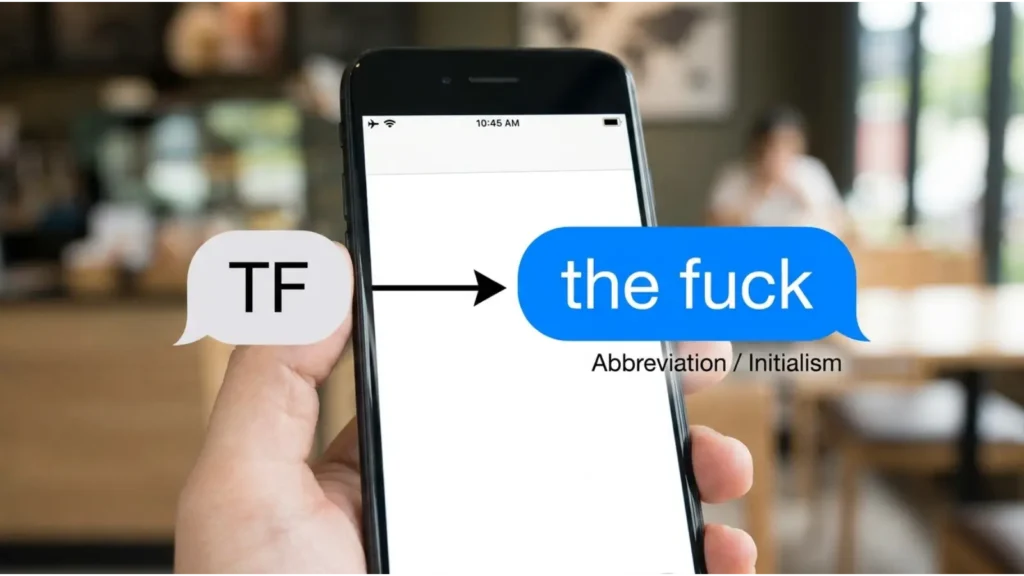
TF Full Form and Meaning
The TF full form in internet slang is the fuck.
The phrase contains profanity, so I would describe TF as vulgar or profane informal slang, rather than ordinary casual English. People often use the abbreviation instead of writing the complete expression, which can make it look less explicit while keeping much of the same emotional force.
Dictionary.com explains that the underlying phrase can function as an intensifier in questions, exclamations, and statements. It also notes that TF became common online during the 2000s, following the wider use of expressions such as WTF.
There are also other meanings of the letters TF outside texting slang. Depending on the subject, TF can refer to things such as TensorFlow, task force, tissue factor, or TransFlash. Therefore, the surrounding context matters when you are interpreting the abbreviation.
How TF Changes the Tone of a Message
One reason the TF meaning in text can be confusing is that the same abbreviation can communicate different emotions.
Surprise
Someone may write TF?! after hearing unexpected news.
Here, the writer may simply be shocked rather than angry.
Confusion
A person who does not understand a situation might say:
What TF is happening?
The phrase communicates strong confusion.
Frustration
TF can also make frustration more obvious.
For example:
Why TF is this app not working?
The writer is probably annoyed with the situation.
Disbelief
If a friend tells you something unbelievable, you might respond:
TF, seriously?
This can communicate that you cannot believe what you just heard.
Humor
Among close friends, TF can also be playful.
A friend sends an obviously ridiculous photograph, and you reply:
TF 😂
The abbreviation may express amused disbelief rather than genuine anger.
This is why I would never judge the tone of TF from the letters alone. The relationship between the people, punctuation, emojis, previous messages, and subject of the conversation can all change how it sounds.
Where People Use TF
TF is mainly associated with informal digital communication. It can appear in several online environments.
Text Messages
Friends may use TF in SMS or private chats when reacting quickly to unexpected information.
WhatsApp and Messenger
In group chats and private conversations, TF can be used as a quick emotional reaction. It is especially common when people already have a relaxed relationship.
TikTok and Instagram
You may see TF in comments, captions, replies, and direct messages. Social media users often use it when reacting to surprising, confusing, funny, or unusual content.
X and Other Social Platforms
Short abbreviations work well in fast-moving social conversations. TF may appear in reactions to news, memes, videos, arguments, or trending topics.
Discord and Gaming Chats
Gaming communities often use highly informal language, and TF can appear when something unexpected happens during a game or voice chat.
Still, the platform does not determine the meaning by itself. The conversation does.
Realistic Conversation Examples
Here are some natural examples showing how the tone can change.
Example one: surprise
Alex: Did you see that he quit his job today?
Sam: TF? He just started last month.
Here, TF expresses surprise and disbelief.
Example two: confusion
Mia: The meeting was moved to 6 a.m.
Jordan: Why TF would they do that?
The abbreviation adds frustration to the question.
Example three: playful reaction
Chris: I accidentally ordered 20 pizzas.
Taylor: TF 😂 What are you going to do with all of those?
Here, the expression is humorous and surprising rather than hostile.
Example four: disbelief
Nina: She says she finished the entire project in one hour.
Ryan: TF? That would take me all day.
The writer is questioning whether the claim is believable.
Example five: possible anger
Dan: You deleted the file again.
Lee: Why TF are you blaming me?
In this situation, TF can make the message sound confrontational. The context is important because the same abbreviation can feel playful between friends but aggressive during an argument.
Origin and Internet History of TF
The exact moment when TF was first typed online is difficult to establish with certainty. I would avoid claiming that one particular person, website, or generation invented it without strong evidence.
The underlying phrase the fuck has a much older history in English. Dictionary.com traces its use as a coarse intensifying expression to the early twentieth century.
The abbreviation TF developed later as part of internet and text-message shorthand.
Dictionary.com records TF as becoming common online in the 2000s and connects its development with the earlier popularity of WTF, meaning what the fuck.
Today, TF belongs to broader internet slang rather than one specific regional dialect. It is used across English-language online communication, particularly where people are comfortable with informal and sometimes profane language.
I would also be careful about labeling TF as exclusively Gen Z slang. Younger internet users certainly use it, but the abbreviation has been established online for much longer than the current social media era.
TF vs WTF
TF and WTF are closely related, but they are not exactly interchangeable in every sentence.
TF is the shorter form and often works as an intensifier.
For example:
- Where TF are you?
- How TF did that happen?
- Who TF said that?
WTF usually means what the fuck and can function as a complete reaction.
For example:
- WTF?
- WTF is happening?
- WTF was that?
In simple terms, TF can be inserted into a sentence to add intensity, while WTF more directly expresses a complete reaction of surprise, confusion, or disbelief.
Synonyms and Softer Alternatives
TF does not have a perfect synonym because its emotional strength depends on context.
However, you can replace it with softer expressions when you want to avoid profanity.
Common alternatives include:
- What the heck?
- What on earth?
- What in the world?
- Seriously?
- Why?
- How did that happen?
- Are you serious?
- I cannot believe this.
- That is surprising.
- What is going on?
These alternatives are safer in mixed company and formal settings.
Common Misunderstandings About TF
One common mistake is assuming that TF always means anger. It does not. Surprise, confusion, humor, frustration, and disbelief are all possible.
Another misunderstanding is treating TF as a formal abbreviation. It is not appropriate simply because it is short. The underlying phrase is profane, so the abbreviation remains informal.
It is also a mistake to assume that every occurrence of TF online means the same thing. In technical, academic, medical, gaming, or business contexts, the letters may represent an entirely different term. Context should always come first.
When You Should Not Use TF
I recommend avoiding TF in situations where respectful and professional language matters.
Do not normally use it in:
- Job applications.
- Formal business emails.
- Academic assignments.
- Official reports.
- Customer service communication.
- Messages to people you do not know well.
- Professional meetings or presentations.
- Communication where profanity could cause offense.
If you are unsure about the other person’s comfort level, choose a neutral expression instead.
A phrase such as What happened? or Are you serious? can communicate the same basic idea without the profanity.
Internal Linking Opportunities
- Recommended Anchor Text: Texting Abbreviations and Their Meanings -> Proposed Link Topic: A guide to common abbreviations used in digital conversations.
- Recommended Anchor Text: WTF Meaning in Text -> Proposed Link Topic: Explanation of WTF, its tone, and common examples.
- Recommended Anchor Text: Internet Slang Terms -> Proposed Link Topic: A complete guide to popular online slang.
- Recommended Anchor Text: Common Texting Slang -> Proposed Link Topic: Everyday slang expressions used in messages and social media.
- Recommended Anchor Text: What Does BTW Mean in Text -> Proposed Link Topic: Meaning and practical use of BTW in digital communication.
Key Takeaways
- TF usually means the fuck in informal texting and internet slang.
- It can express surprise, confusion, disbelief, frustration, or emphasis.
- Tone depends heavily on context, punctuation, relationship, and surrounding words.
- TF is common in casual messages, social media, gaming chats, and online discussions.
- The abbreviation contains profanity, so it is not suitable for most formal or professional communication.
- TF can have completely different meanings in technical and professional contexts.
Frequently Asked Questions
What does TF mean in texting?
TF most commonly means the fuck. It is an informal abbreviation used to add strong emotion to a question, reaction, or statement. Depending on context, it can communicate surprise, confusion, disbelief, frustration, or humor.
What does TF mean in a chat?
In casual chat, TF usually has the same meaning. A message such as TF? can be a short reaction to something surprising or confusing, while phrases such as Why TF or How TF use the abbreviation to make the question more intense.
Is TF a bad word?
TF represents a profane expression, so it should be treated as vulgar slang. The abbreviation may look less explicit than the complete phrase, but it can still sound rude or offensive in the wrong setting.
Does TF always mean the fuck?
No. In texting and internet slang, that is the most common meaning, but TF has many meanings in other fields. For example, it can refer to technical or scientific terms. Context is necessary to identify the intended meaning.
What does TF mean on TikTok?
On TikTok and similar social platforms, TF usually means the fuck. People commonly use it in comments or replies to express surprise, confusion, disbelief, annoyance, or humorous shock.
What is the difference between TF and WTF?
TF is generally a shorter form used within expressions such as How TF or Why TF. WTF normally means what the fuck and is often used as a complete reaction, such as WTF? Both can express strong surprise or disbelief.
Is TF appropriate at work?
Usually, no. Because TF represents profanity, I would avoid it in professional emails, workplace messages, reports, and communication with clients or senior colleagues. A neutral expression is a safer choice.
Conclusion
The TF meaning in text is usually the profane expression the fuck, used as a short way to add emotional force to digital communication. It can show confusion, surprise, disbelief, frustration, or humor, so the exact tone depends on the conversation.
The most important point is context. TF may feel harmless and funny between close friends but disrespectful in a professional conversation.
Also remember that TF has meanings outside internet slang, so technical or specialized contexts may require a completely different interpretation.
When in doubt, a softer phrase such as What the heck? or Are you serious? is usually the better choice.

My name is Tayyab Abbas, and I am the lead content author at TermsDefine.com. Holding a Master’s degree in English along with 5+ years of dedicated linguistic research experience, I focus on transforming complex terminology, word definitions, and technical jargon into clear, easy-to-understand explanations. Every entry, context guide, and meaning published on this platform is thoroughly researched, drafted, and verified by me to maintain the highest standards of accuracy and real-world clarity. My objective is to provide readers with an authoritative, dependable dictionary resource for all their vocabulary needs.
1 thought on “TF Meaning in Text: What It Means, How to Use It, and Examples”