

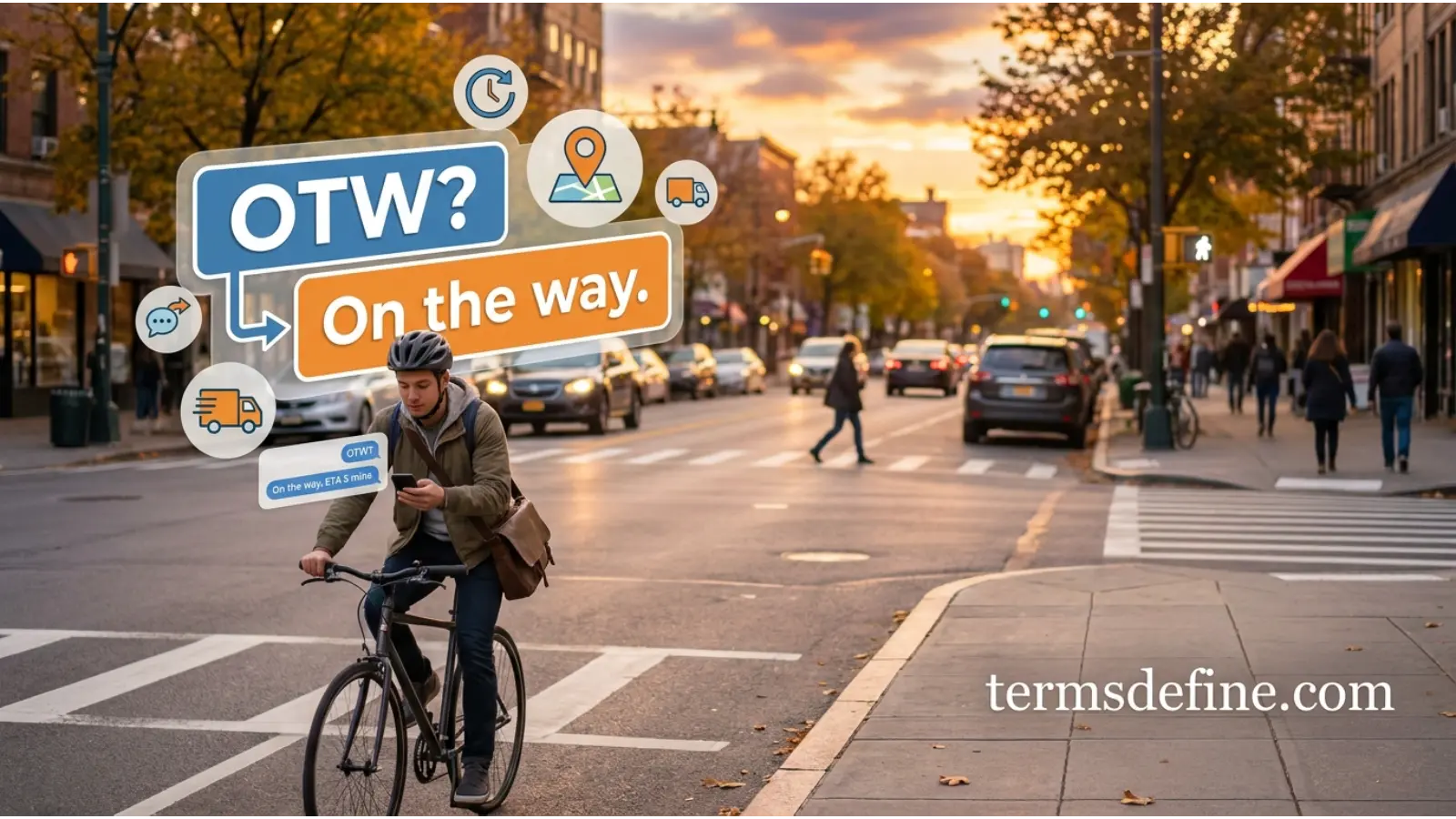
Ever received a message that simply says “OTW” and wondered whether the person is already leaving, almost there, or just saying they plan to come? The OTW meaning in text is usually simple, but the exact message can depend on context.
In everyday digital communication, OTW meaning in text is most commonly “on the way,” a short expression used to say that someone or something is heading toward a destination.
You may see OTW meaning in text in SMS messages, WhatsApp chats, Instagram DMs, Snapchat conversations, group chats, and other informal online spaces.
It is especially useful when someone asks, “Where are you?” or “Are you coming?” Understanding the phrase also means knowing its tone, timing, alternative meanings, and when a clearer phrase is better.
Quick Answer:
OTW usually means “on the way.” It tells someone that a person, item, or sometimes an event is moving toward a destination or expected to arrive soon.
In some contexts, OTW can have other meanings, but “on the way” is the standard interpretation in casual texting.
What Does OTW Mean in Text?
OTW stands for “on the way.”
It is a texting abbreviation or initialism used to communicate movement, arrival, or progress without writing the full phrase.
For example:
- “I’m OTW.” = I’m on the way.
- “OTW to your place.” = I’m on the way to your place.
- “Food is OTW.” = The food is on the way.
- “She’s OTW now.” = She is currently heading there.
The most important detail is that OTW normally gives an update about movement. It often reassures the other person that the journey has started or that something is coming.
It can answer questions such as:
- “Where are you?”
- “Are you coming?”
- “How long until you get here?”
- “Did you order the food?”
- “Has the package been sent?”
In other words, three letters can replace an entire sentence.

OTW Full Form
The full form of OTW is “On The Way.”
It is an informal abbreviation rather than a formal English expression. Like many internet abbreviations, it removes unnecessary words while keeping enough information for the reader to understand the message.
You may see it written as OTW, otw, or occasionally Otw. Capitalization usually does not change the meaning.
OTW vs. OMW
OTW is closely related to OMW, which means “on my way.”
There is a small difference:
- OTW: On the way
- OMW: On my way
“OMW” specifically points to the speaker, while “OTW” can be broader.
For example:
“I’m OMW” clearly means the sender is traveling.
“The driver is OTW” means the driver is coming.
Both can be perfectly natural in casual texting.
What Does OTW Really Imply?
The phrase sounds straightforward, but there is a useful social nuance.
When someone says “OTW,” most readers interpret it as “I have started heading there” or “I’m coming.” However, it does not always provide an exact arrival time.
That matters because “OTW” and “I’ll be there in five minutes” are not equivalent.
Someone can technically be OTW while still being 30 minutes away.
This is why people often combine the abbreviation with an estimated arrival time:
“OTW, about 15 mins.”
That message is much more informative because it confirms both movement and timing.
The expression can also be used for things rather than people:
“Your order is OTW.”
Here, the item is being transported toward the customer.
So the phrase can describe travel, delivery, progress, or something approaching its destination.
Where Is OTW Used?
OTW is mainly found in informal digital communication.
Text Messages and SMS
Traditional texting is one of the most natural places to see OTW.
Someone might write:
“Running late but OTW.”
It is short, practical, and easy to understand.
WhatsApp conversations frequently use short forms because people often communicate through quick messages.
For example:
“Dinner ready?”
“Yep, OTW.”
The abbreviation keeps the conversation fast without sounding overly formal.
Instagram and Snapchat
OTW can appear in DMs, group chats, captions, or quick replies when people are arranging plans.
For example:
“We’re OTW to the concert.”
The tone remains casual and social.
TikTok
OTW may appear in comments, direct messages, captions, or conversations connected with plans and meetups. However, it is not a TikTok-specific term. Its meaning remains the same across platforms.
Discord and Gaming Chats
Players can also use OTW when discussing movement inside or outside a game:
“OTW to your lobby.”
The exact meaning depends on the surrounding conversation, but “on the way” remains the likely interpretation.
Realistic Conversation Examples
The easiest way to understand this texting slang is to see how people actually use it.
Example 1: Meeting a Friend
Alex: “Where are you? We’re already at the café.”
Sam: “OTW. Traffic is horrible.”
Here, OTW means Sam has started traveling toward the café.
Example 2: Making Plans
Mia: “Are you still coming tonight?”
Jordan: “Yeah, OTW soon.”
This suggests Jordan is heading over soon, although it does not necessarily mean they have already left.
Example 3: Food Delivery
Ali: “Did you order the pizza?”
Hamza: “Yep, it’s OTW.”
Here, the abbreviation describes the pizza or delivery rather than the sender.
Example 4: Asking for an ETA
Sara: “OTW?”
Nina: “Yes, about 10 minutes.”
The first message uses OTW almost like a question: “Are you on the way?”
Example 5: Group Chat
Chris: “Everyone at the stadium?”
Taylor: “OTW!”
This is a quick status update telling the group that Taylor is heading there.
OTW Tone and Emotional Meaning
OTW is generally casual, neutral, and practical.
It does not automatically sound romantic, excited, annoyed, or serious. The emotional meaning comes from the surrounding words.
Compare:
“OTW ❤️”
This can sound warm or affectionate.
“OTW, chill.”
This can sound slightly irritated or defensive.
“OTW!!!”
The extra punctuation can make the message feel more energetic or excited.
So the abbreviation itself does not carry a strong emotional tone. Context, punctuation, emojis, and the relationship between the people determine the mood.
OTW in Different Situations
The meaning can become slightly broader depending on what is being discussed.
A Person Is Traveling
“I’m OTW home.”
The person is traveling toward home.
A Package Is Coming
“Your shoes are OTW.”
The shoes are being delivered.
Food Is Coming
“The burgers are OTW.”
The food has been sent or is being transported.
Something Is Progressing
In casual communication, people may extend the idea metaphorically:
“The update is OTW.”
This means the update is coming or expected soon.
Still, when the context is unclear, writing the full phrase can avoid confusion.
Origin and History of OTW
The exact origin of OTW is not firmly documented.
Several online slang references identify it as an abbreviation for “on the way,” and an abbreviation database records a texting entry dating to 2011. Other slang references have documented its use for many years, including examples from the early 2000s.
It is reasonable to connect abbreviations like OTW with the broader culture of SMS and online messaging, where shorter expressions make communication quicker. However, claims that a particular person, website, or platform invented OTW are not reliably established.
That distinction matters.
The abbreviation follows a very natural pattern: taking the first letters of On The Way. Similar shorthand developed across digital communication without necessarily having one identifiable creator.
OTW also appears outside ordinary texting. Wiktionary records it as an initialism of “on the way,” while also listing “overtime win” as a sports-related meaning.
Does OTW Have Other Meanings?
Yes, but context is important.
The overwhelmingly familiar texting meaning is “on the way.”
Some slang references also document “off to work” as another possible meaning.
For example:
“OTW, talk later.”
In a workplace-related conversation, someone could intend “off to work,” although this interpretation is less common and can easily create confusion.
There are also specialized meanings in fields such as sports and organizations. For instance, “overtime win” may appear in sports contexts.
Therefore, do not automatically assume every OTW means “on the way” if the surrounding conversation clearly belongs to a specialized field.
Synonyms and Similar Texting Terms
Several phrases communicate an idea similar to OTW:
- OMW — On my way
- En route — Traveling toward a destination
- Coming — Heading toward someone or somewhere
- Heading over — Going to a particular place
- On the move — Currently traveling or moving
- Almost there — Very close to the destination
- ETA — Estimated time of arrival
There is no exact antonym for OTW, but expressions such as “not coming,” “still here,” “staying put,” or “I haven’t left yet” communicate the opposite idea.
Common Misunderstandings About OTW
One common misunderstanding is assuming that OTW always means “I have already left.”
In casual texting, some people use it loosely to mean “I’m coming” or “I’m about to leave.” That is why the abbreviation alone does not guarantee a precise location.
Another mistake is assuming OTW means “on my way.” That is closer to OMW. Although people may use OTW in similar situations, the literal expansion is “on the way.”
A third misunderstanding is treating OTW as a professional business language.
It is understandable in informal workplace chats, but it is usually better to write:
“I’m on my way.”
or:
“I’ll arrive in approximately 15 minutes.”
These alternatives are clearer and more professional.
When Should You NOT Use OTW?
Avoid OTW when the audience may not understand texting abbreviations.
For example, in a formal email, client communication, academic writing, legal document, or official notice, use the complete phrase instead.
Instead of:
“OTW to the office.”
Write:
“I’m on my way to the office.”
Instead of:
“Package OTW.”
Write:
“Your package is on the way.”
The full phrase takes only a few extra characters but removes possible ambiguity.
Key Takeaways
- OTW usually means “on the way.”
- It is mainly used in texts, chats, DMs, and other informal digital communication.
- It can describe a person, delivery, food, or something else that is approaching.
- OMW is similar but specifically means “on my way.”
- OTW does not always provide an exact arrival time.
- Other meanings exist, but they depend heavily on context.
- Use “on the way” instead of OTW in formal or professional communication.
FAQs
What does OTW mean in text?
OTW means “on the way.” It usually tells someone that a person or thing is traveling toward a destination.
What does OTW mean from a girl?
The abbreviation has no special gender-based meaning. If someone sends “OTW,” it normally means “on the way,” regardless of who sends it.
What does OTW mean from a guy?
It normally means “on the way.” The sender is saying they are heading somewhere or that something is coming.
Is OTW the same as OMW?
They are similar, but not identical. OTW means “on the way,” while OMW means “on my way.”
Is OTW formal or informal?
OTW is informal. It works well in texts, DMs, group chats, and casual conversations but is usually not suitable for formal writing.
Can OTW mean something other than “on the way”?
Yes. Some contexts use OTW for meanings such as “off to work” or sports-related terms such as “overtime win.” Context determines the intended meaning.
How do you reply to OTW?
A simple reply can be “Okay,” “See you soon,” “How far are you?” or “Great, drive safely.” Your response depends on the situation.
Does OTW mean someone has already left?
Not necessarily. Usually it suggests movement toward a destination, but people sometimes use it loosely to mean they are coming or preparing to leave.
Conclusion
The most common OTW meaning in text is “on the way,” making it a simple shortcut for telling someone that a person, delivery, or other thing is coming toward a destination.
Its possibilities can change in specialized contexts, but everyday texting almost always points to the familiar meaning.
OTW works because it is fast, recognizable, and easy to fit into a quick message. Still, it does not give an exact arrival time, and it can be ambiguous when the context is unclear. For casual conversations, it is perfectly natural. For professional or formal communication, spelling out “on the way” is usually the clearer choice.

My name is Tayyab Abbas, and I am the lead content author at TermsDefine.com. Holding a Master’s degree in English along with 5+ years of dedicated linguistic research experience, I focus on transforming complex terminology, word definitions, and technical jargon into clear, easy-to-understand explanations. Every entry, context guide, and meaning published on this platform is thoroughly researched, drafted, and verified by me to maintain the highest standards of accuracy and real-world clarity. My objective is to provide readers with an authoritative, dependable dictionary resource for all their vocabulary needs.