

CYA Meaning in Text: What Does CYA Mean in a Text?
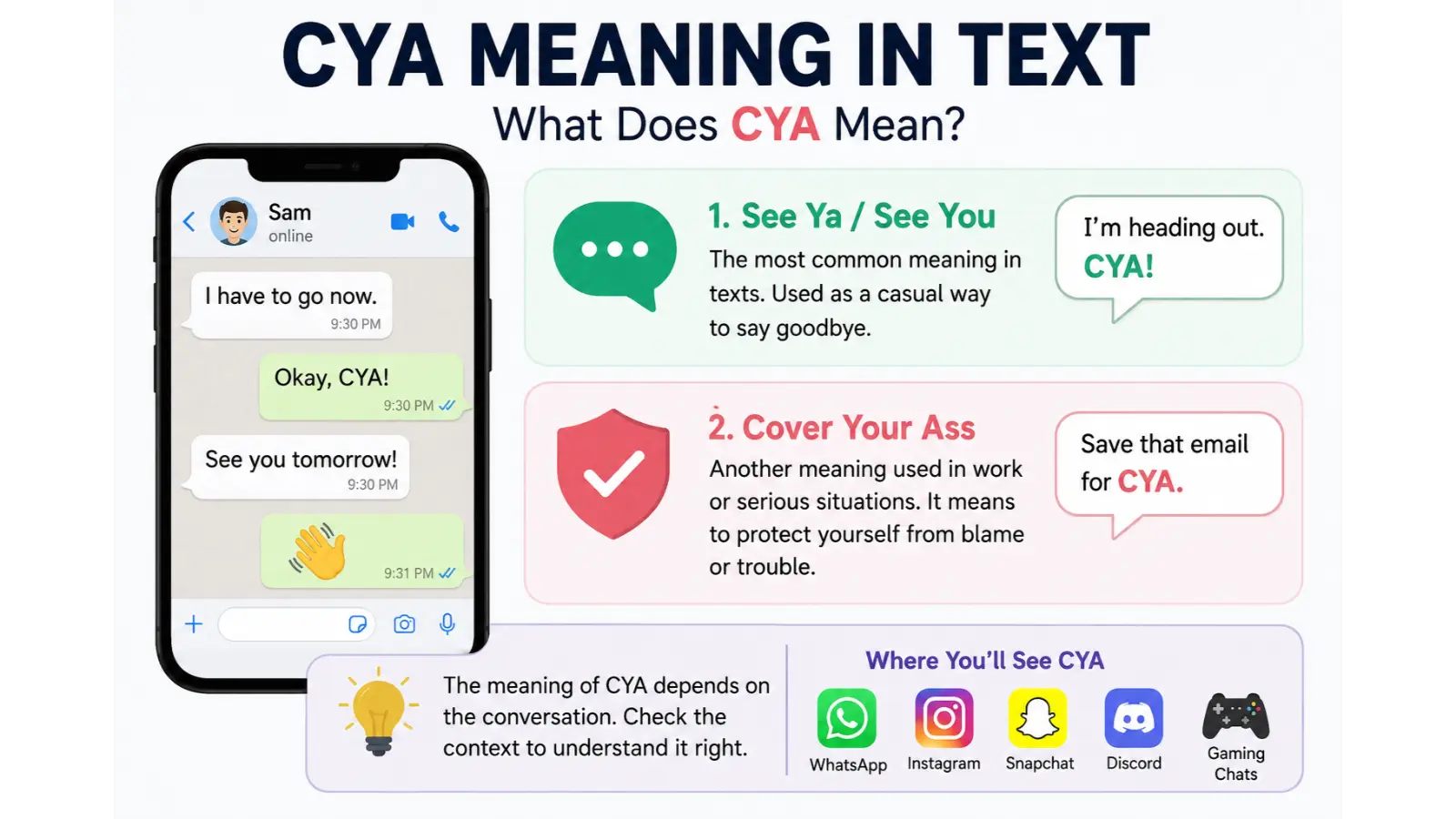
If I receive a text that simply says “CYA!”, I would usually read it as a quick, casual way of saying “see ya” or “see you.”
It is the kind of short expression people use when they are ending a conversation, leaving a group chat, or saying goodbye before heading somewhere.
I may see CYA in text messages, online chats, social media conversations, gaming chats, or casual emails. But there is one important detail: CYA has another established meaning.
In workplace or business conversations, it can mean “cover your ass,” referring to protecting yourself from blame, trouble, or possible consequences. Dictionaries recognize both uses, so the surrounding conversation matters.
Quick answer:
In everyday texting, CYA usually means “see ya” or “see you.” It is a casual goodbye. However, in work-related conversations, CYA can also mean “cover your ass,” so context is the easiest way to determine the intended meaning.
Quick Answer: What Does CYA Mean in Text?
CYA most commonly means “see ya” or “see you” when used in casual texting. It is an informal farewell similar to “bye,” “later,” or “see you soon.”
For example:
“I gotta go. CYA!”
This simply means:
“I have to go. See you!”
CYA has a second meaning, “cover your ass,” which is informal and sometimes vulgar. In that context, it means taking steps to protect yourself from blame, criticism, trouble, or responsibility.
What Does CYA Stand For?
CYA can represent two different phrases:
| CYA | Meaning | Typical context |
| See ya / See you | A casual goodbye | Texting, chats, social media |
| Cover your ass | Protect yourself from possible blame or trouble | Workplace, business, disputes |
When CYA means “see ya,” it is really texting shorthand based on the informal pronunciation of “see you.”
When it means “cover your ass,” the letters directly correspond to the first letters of the three words.
For a general audience, it is simplest to call CYA a texting abbreviation rather than worry about whether every use technically qualifies as an acronym or initialism.
CYA Meaning as “See Ya”
This is the meaning I would expect first in an ordinary conversation between friends.
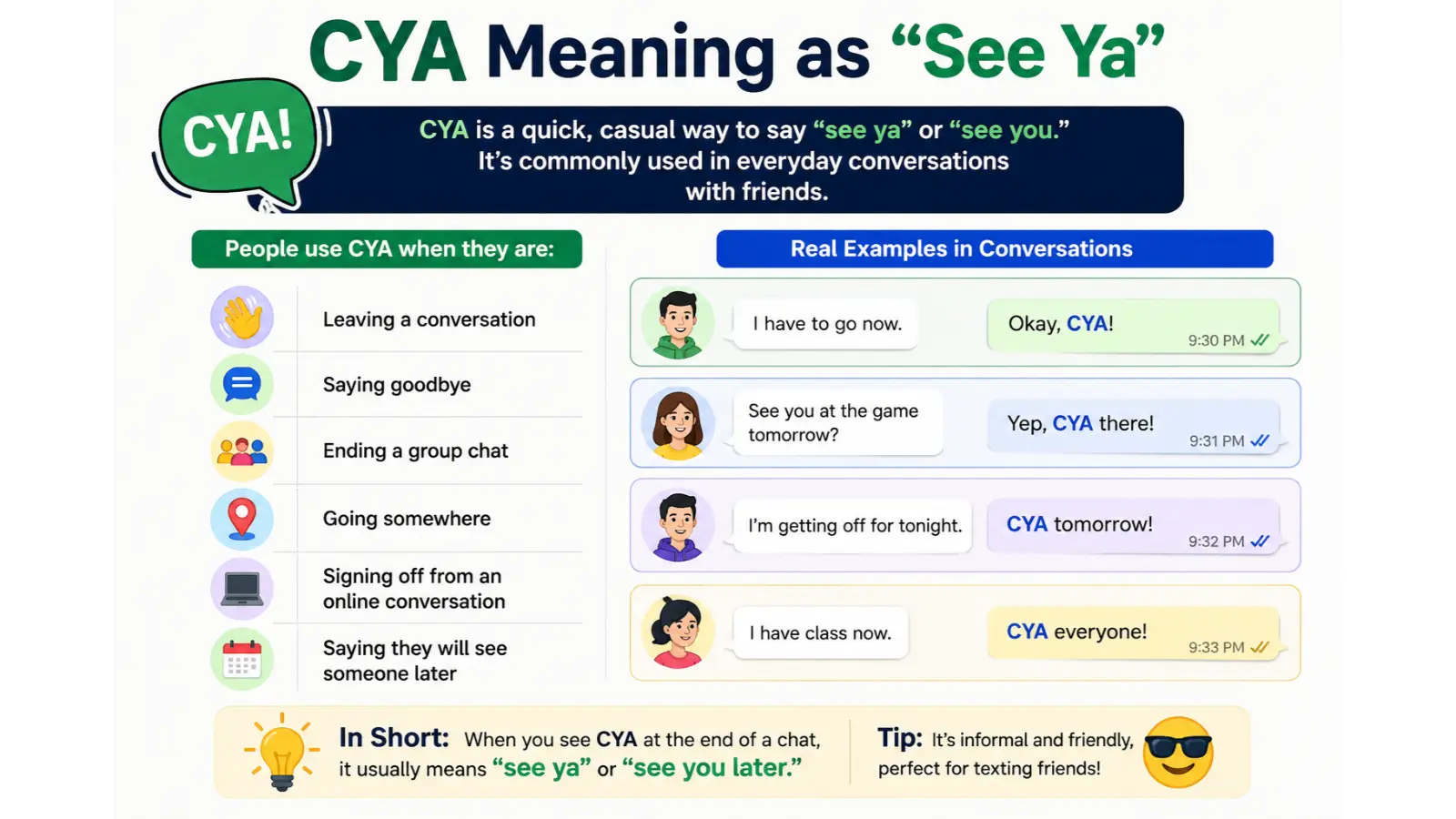
People use CYA when they are:
- Leaving a conversation
- Saying goodbye
- Ending a group chat
- Going somewhere
- Signing off from an online conversation
- Saying they will see someone later
Real examples
Friend: “I need to finish my homework.”
You: “Okay, CYA later!”
Here, CYA means “see ya later.”
Another example:
Sam: “Are you coming tomorrow?”
Alex: “Yep, CYA then.”
Here, the meaning is “see you then.”
The abbreviation is short, casual, and easy to understand when the conversation is already informal.
CYA in Real Text Conversations
Here are some situations where CYA sounds natural.
Ending a conversation
Mia: “I have to go now. My ride is here.”
Zoe: “Okay, CYA!”
Meaning: See you!
Making plans
Ryan: “See you at the game tomorrow?”
Noah: “Yep, CYA there.”
Meaning: See you there.
Going offline
Jay: “I’m getting off for tonight.”
Chris: “CYA tomorrow.”
Meaning: See you tomorrow.
Leaving a group chat
Ava: “I have class now. CYA everyone!”
Liam: “Later!”
Again, it is simply a quick goodbye.
CYA Meaning in Different Contexts
In texting
If I see “CYA” at the end of a normal conversation, I would usually interpret it as “see ya.”
For example:
“I’m heading home now, cya!”
There is no hidden meaning. The person is saying goodbye.
On social media
CYA can also appear in casual comments, direct messages, or group conversations. The meaning remains dependent on the surrounding message.
“CYA at the event!”
Here, it means “see you at the event.”
In gaming
In a gaming chat, CYA can be used when someone leaves a game or logs off.
“I’m done for tonight. CYA tomorrow.”
That means “see you tomorrow.”
The same abbreviation can have a different meaning in a gaming discussion about responsibility or mistakes, so context still matters.
At work
Workplace conversations are where CYA becomes more ambiguous.
Someone might write:
“Save that email for CYA.”
Here, they probably do not mean “see ya.” They mean “cover your ass”—in other words, keep a record that could protect you if someone later questions what happened.
This workplace use is recognized by dictionaries and is associated with protective business practices.
CYA Meaning: “Cover Your Ass”
The second major meaning is very different.
“Cover your ass” means taking sensible precautions to protect yourself from possible blame, criticism, trouble, or consequences.
For example:
“Keep a copy of the message. CYA.”
The speaker is essentially saying:
“Keep a record so you can protect yourself later if there is a problem.”
This meaning may appear when people are discussing:
- Documentation
- Workplace disagreements
- Responsibility
- Mistakes
- Instructions
- Evidence or records
- Possible consequences
It is much less likely to be the intended meaning in a simple conversation between friends.
Because the phrase contains “ass,” this version is informal and can sound vulgar. Collins specifically labels the American-English expansion as slang and sometimes vulgar.
How Can I Tell Which Meaning Someone Means?
The easiest method is to look at what is happening in the conversation.
| If CYA appears… | It probably means… |
| After “I have to go” | See ya |
| After making plans | See ya / see you |
| When someone is leaving a chat | See ya |
| Before someone logs off | See ya |
| During a discussion about paperwork | Cover your ass |
| When someone says to keep records | Cover your ass |
| During a workplace disagreement | Cover your ass |
| When discussing possible blame | Cover your ass |
A useful rule is:
If someone is leaving, CYA probably means “see ya.” If someone is protecting themselves, it may mean “cover your ass.”
Is CYA Rude?
When CYA means “see ya,” it is generally not rude. It is simply casual.
However, tone can still depend on the situation.
For example:
“Fine. CYA.”
After an argument, that could feel cold or dismissive. The feeling comes more from the overall conversation than from the abbreviation itself.
The “cover your ass” meaning is different. Because it contains profanity, it can sound blunt or inappropriate in formal situations.
CYA vs. Similar Texting Abbreviations
CYA is sometimes confused with other short forms used in messages.
| Abbreviation | Meaning | Main difference |
| CYA | See ya / see you | Casual farewell |
| TTYL | Talk to you later | Focuses on talking again |
| GTG | Got to go | Says you need to leave |
| BRB | Be right back | Says you will return soon |
| L8R | Later | Very casual way to say goodbye |
1 CYA vs. TTYL
CYA is basically a farewell:
“CYA tomorrow!”
TTYL focuses more specifically on communicating again:
“I have to go. TTYL.”
They can have similar effects in a conversation, but they are not exactly the same.
CYA vs. GTG
GTG tells someone that you need to leave:
“GTG, my bus is here.”
CYA is the goodbye:
“CYA tomorrow!”
You can even use both:
“GTG, CYA tomorrow!”
Is CYA Formal?
No. When CYA means “see ya,” it is informal texting language.
I would avoid it in:
- Formal business letters
- Academic writing
- Official documents
- Formal customer communication
- Professional messages where a polished tone is expected
Instead, use:
- “See you soon.”
- “See you tomorrow.”
- “Talk to you later.”
- “Best regards.”
- “I look forward to speaking with you.”
The workplace meaning of CYA is also slang, so a professional alternative is usually clearer.
Instead of:
“Keep that email for CYA.”
A more professional version would be:
“Please keep that email for your records.”
Common Misunderstandings About CYA
“CYA always means see ya.”
Not always. “Cover your ass” is another established meaning, particularly in workplace and business contexts.
“CYA is always rude.”
No. In casual texting, CYA is usually just a friendly or neutral goodbye.
“CYA means something romantic.”
Not by itself. CYA does not automatically communicate romantic interest. The surrounding conversation and relationship between the people matter more.
“CYA always means cover your ass.”
That is also incorrect. In an ordinary text such as:
“Okay, I gotta go. CYA!”
the farewell meaning is much more natural.
How Should I Reply to “CYA”?
If the person means “see ya,” you can respond naturally with:
- “See you!”
- “Later!”
- “Cya!”
- “Talk soon!”
- “See you tomorrow!”
For example:
Them: “I gotta go. CYA!”
You: “Later! See you tomorrow.”
If the person means “cover your ass,” a practical response makes more sense:
Them: “Keep the confirmation email. CYA.”
You: “Good idea. I’ll save it.”
The surrounding conversation should make the intended meaning clear.
Key Takeaways
- CYA Meaning in Text “see ya” or “see you” in casual texting.
- It is commonly used as a quick, informal goodbye.
- CYA can also mean “cover your ass” in workplace or business contexts.
- The subject of the conversation is the best clue to the intended meaning.
- “See ya” is casual, so it is better suited to friends and informal chats than formal writing.
- The “cover your ass” meaning is slang and contains profanity, so professional alternatives are often better.
FAQs:
What does CYA Meaning in Text from a friend?
Usually, CYA means “see ya” or “see you.” If your friend writes “CYA later,” they are simply saying they will see you later.
Does CYA mean goodbye?
Yes. In casual texting, CYA can be a shortened way to say goodbye or “see you.”
What does CYA mean at work?
In a workplace context, CYA may mean “cover your ass.” It refers to protecting yourself from possible blame or trouble, often by keeping records or documentation.
Is CYA rude?
Usually not when it means “see ya.” It is simply informal. However, the “cover your ass” meaning contains profanity and may sound inappropriate in professional situations.
What does CYA mean on Snapchat?
In a casual Snapchat conversation, CYA will usually mean “see ya” or “see you.” The surrounding message can confirm the meaning.
Is CYA the same as TTYL?
Not exactly. CYA means “see ya” or “see you,” while TTYL means “talk to you later.” Both can be used when ending an informal conversation.
Can CYA mean “see you later”?
Yes. Depending on the sentence, CYA can function like “see you later.” For example, “I have to go, CYA later!” is simply a casual goodbye.
Should I use CYA in a professional email?
Usually, no. If you mean “see you,” choose a clearer professional closing such as “See you soon,” “Talk to you later,” or “Best regards.”
Conclusion
When I see CYA in an ordinary text, the safest first interpretation is “see ya” or “see you.” It is a short, casual farewell that fits naturally into conversations with friends, group chats, gaming chats, and other informal communication.
The important exception is context. In workplace or business conversations, CYA can mean “cover your ass,” referring to protecting yourself from possible blame or consequences. Since both meanings are established, the surrounding words usually reveal which one the sender intended.
So, if someone texts “Okay, CYA!”, they are almost certainly saying “See ya!” If someone tells you to “keep that email for CYA,” they are talking about protecting themselves—not saying goodbye.

My name is Tayyab Abbas, and I am the lead content author at TermsDefine.com. Holding a Master’s degree in English along with 5+ years of dedicated linguistic research experience, I focus on transforming complex terminology, word definitions, and technical jargon into clear, easy-to-understand explanations. Every entry, context guide, and meaning published on this platform is thoroughly researched, drafted, and verified by me to maintain the highest standards of accuracy and real-world clarity. My objective is to provide readers with an authoritative, dependable dictionary resource for all their vocabulary needs.