

PMO Meaning in Text: What Does PMO Mean in Texting and Social Media?
If you have ever received a text saying “PMO” and wondered what those three letters actually mean, you are not alone.
PMO meaning in text can be confusing because the abbreviation has more than one common meaning, and the right definition depends heavily on context.
In casual texting, social media comments, TikTok posts, and online chats, PMO most often means “Put Me On” or “Piss Me Off.”
The first is usually a friendly request for a recommendation, introduction, or useful information.
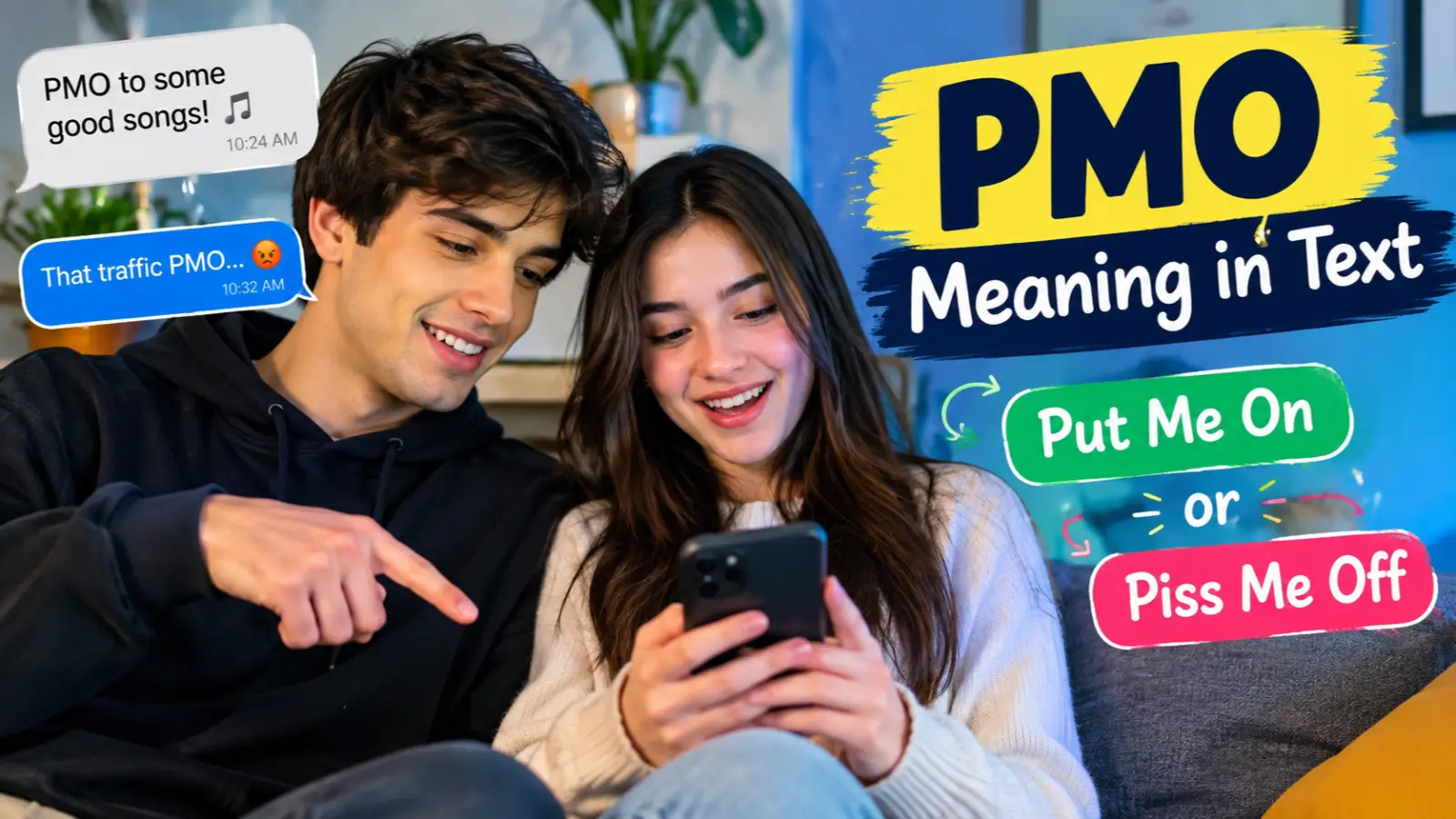
The second expresses annoyance, frustration, or anger. For example, “PMO to some good songs” means “recommend some good songs to me,” while “That traffic PMO” shows irritation.
Understanding the sentence around PMO is the easiest way to identify its intended meaning. In this guide, we’ll explore both meanings, real texting examples, social media usage, tone, and when you should avoid using this slang.
Quick Answer 💬
PMO meaning in text usually refers to either “Put Me On” or “Piss Me Off.” “Put Me On” is generally used when someone wants a recommendation, introduction, or information, while “Piss Me Off” expresses annoyance or frustration.
The surrounding words and tone usually make the intended meaning clear.
For example, “PMO to some good songs” is probably asking for recommendations, while “That traffic PMO” expresses irritation.
That double meaning is what makes PMO interesting—and occasionally confusing.
What Does PMO Mean in Text?
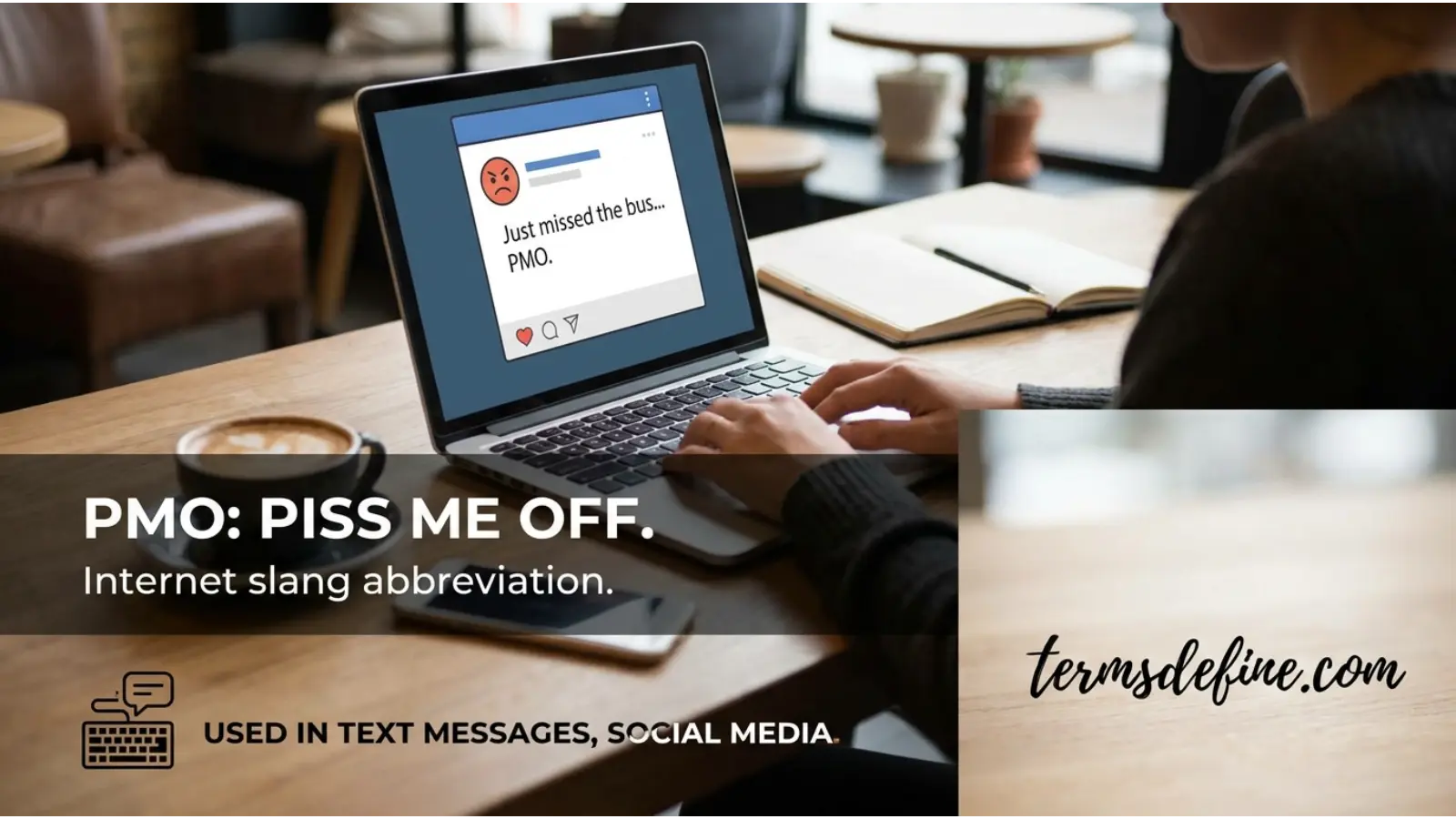
PMO is an internet slang abbreviation used in casual digital communication. Unlike abbreviations such as “LOL,” which usually have one widely understood meaning, PMO can point in two very different directions.
The two major slang meanings are:
| PMO meaning | What it communicates | Typical tone |
| Put Me On | Recommend, introduce, or show me something | Curious, friendly |
| Piss Me Off / Pisses Me Off | Annoy or frustrate me | Negative, irritated |
The easiest way to understand the abbreviation is to look at what surrounds it.
If someone writes:
“PMO to some new artists.”
They are probably saying “Put me on to some new artists.” In other words, they want recommendations.
But:
“People who cancel at the last minute PMO.”
means something closer to “People who cancel at the last minute piss me off.”
So, when you see PMO in a message, don’t automatically assign one definition to it. Context does the heavy lifting.
PMO Full Form and Its Two Main Meanings
Because PMO is an abbreviation, its full form changes according to the conversation.
1. PMO = Put Me On
“Put me on” is a casual expression meaning to recommend something to me, introduce me to something, or let me in on something interesting.
It can involve music, movies, food, fashion, hobbies, places, people, or information.
For example:
- “PMO to some good rap albums.”
- “You always know good restaurants. PMO.”
- “PMO to your favorite Netflix shows.”
- “She seems cool. PMO to her.”
- “PMO some good sneakers.”
Here, the speaker is asking another person to share something they know or like.
The phrase is related to the broader expression “put me on to”, which means introducing someone to something they may not know about. Wiktionary records PMO as an internet-slang initialism for “put me on (to)” and provides examples from social media usage.
2. PMO = Piss Me Off / Pisses Me Off
The second meaning is much more negative.
Here, PMO expresses annoyance, irritation, or anger. Depending on the grammar of the sentence, it can represent forms such as “piss me off,” “pisses me off,” or “pissing me off.”
Examples include:
- “That noise PMO.”
- “My Wi-Fi keeps disconnecting and it’s PMO.”
- “People who lie for no reason PMO.”
- “This traffic is PMO.”
- “That really PMO.”
This usage is informal and contains profanity, even when abbreviated. That’s important when deciding whether the term is appropriate for a particular audience.
How Do You Know Which Meaning Someone Means?
This is the most important part of understanding PMO.
Look at the emotional direction of the sentence.
If the person is asking for something, PMO probably means “Put Me On.”
If the person is complaining about something, it probably means “Piss Me Off.”
Consider these examples:
“PMO to some good movies.”
→ They want recommendations.
“That movie ends with PMO.”
→ The ending annoyed them.
“PMO to that clothing brand.”
→ Tell me about or recommend that brand.
“These prices are PMO.”
→ These prices are frustrating me.
This is a classic example of why internet slang cannot always be translated word-for-word. The same three letters can express curiosity or irritation depending on the surrounding language.
PMO in Texting and Private Chats 📱
In ordinary texting, PMO tends to appear between people who already understand casual internet language.
A friend might send:
Friend 1: “You said you found a good coffee shop.”
Friend 2: “Yeah, PMO? I need the name.”
Here, PMO means “Put me on”—essentially, “Tell me about it.”
The frustration meaning can be equally natural:
Friend 1: “He canceled again five minutes before we left.”
Friend 2: “Nah, that PMO.”
The second speaker is expressing annoyance.
In both cases, the surrounding conversation makes the meaning obvious.
PMO on TikTok and Social Media
PMO became especially visible in online slang culture through social media, including TikTok.
The “Put Me On” meaning appeared in TikTok trends during the early 2020s, including posts using constructions such as “PMO to your…” where people introduced viewers to friends or other subjects. Know Your Meme reports that this usage became popular on TikTok around 2021–2022.
The frustration meaning has a much older online history. Know Your Meme traces a “pisses me off” definition to an Urban Dictionary entry from December 2005, while a “put me on” definition was added in 2016.
More recently, PMO became part of viral slang-heavy TikTok and meme language. It has sometimes appeared alongside abbreviations such as TS and ICL, creating intentionally exaggerated “slang overload” phrases.
However, social-media popularity does not mean every user interprets PMO identically. Different online communities can favor different meanings.
PMO and Internet Culture
One interesting feature of PMO is that its two meanings developed along somewhat different paths.
The “piss me off” interpretation predates the more recent social-media popularity of PMO. The “put me on” interpretation later became prominent in online recommendation culture.
That history also shows why calling PMO exclusively “Gen Z slang” can be misleading.
It is certainly common in contemporary social media, but the abbreviation itself has been used online for much longer. Recent TikTok culture helped expose the term to a much wider audience rather than inventing every use of it from scratch.
There is also an important cultural point here: discussions of modern slang often overlap with AAVE and Black internet culture, particularly around expressions that later spread through mainstream social platforms. Know Your Meme notes that “put me on” usage was associated with Black internet users before its wider TikTok circulation.
Because slang spreads across communities, the exact point at which a phrase became “mainstream” can be difficult to establish. It is better to distinguish documented usage from claims about a single person or platform inventing the term.
Realistic PMO Conversation Examples
Example 1: Asking for a Recommendation
Alex: “That playlist you posted was actually fire.”
Jordan: “Haha thanks.”
Alex: “PMO to more artists like that.”
Meaning: Alex wants Jordan to recommend more artists.
Example 2: Asking About Food
Mia: “Where did you get that burger?”
Sam: “This little place downtown.”
Mia: “PMO, I need to try it.”
Meaning: Mia wants Sam to tell her about or recommend the restaurant.
Example 3: Expressing Annoyance
Ryan: “The train is delayed again.”
Chris: “Seriously?”
Ryan: “Yeah, this PMO.”
Meaning: The situation is frustrating Ryan.
Example 4: Social Media Comment
Comment: “PMO to some good horror movies.”
Meaning: “Recommend some good horror movies to me.”
Example 5: A Frustrated Reaction
Comment: “People who spoil endings PMO.”
Meaning: “People who spoil endings piss me off.”
Notice how the meaning changes completely even though the abbreviation stays exactly the same.
Synonyms and Similar Expressions
When PMO means “Put Me On,” similar expressions include:
- Recommend something
- Put me onto something
- Show me
- Tell me about it
- Introduce me to it
- Hook me up
- Share your recommendations
When PMO means “Piss Me Off,” similar expressions include:
- Annoy me
- Irritate me
- Frustrate me
- Make me angry
- Get on my nerves
- Bother me
There is no perfect synonym for every situation because PMO carries the fast, informal style of internet communication.
Common Misunderstandings About PMO ⚠️
Assuming PMO Always Means “Piss Me Off”
This is one of the biggest mistakes.
A message such as “PMO to some good music” clearly points toward “Put Me On.” Automatically reading it as “piss me off” would completely reverse the speaker’s intention.
Assuming PMO Always Means “Put Me On”
The opposite mistake is just as common.
If someone says:
“That behavior PMO.”
they are almost certainly complaining, not asking for a recommendation.
Confusing Slang PMO With Business PMO
Outside internet slang, PMO has other meanings. In business and project-management environments, PMO commonly means Project Management Office.
That is a completely different use.
Therefore, if you see PMO in a work document, project plan, or corporate discussion, don’t assume it refers to texting slang.
Thinking It Is Professional Language
PMO is best kept to informal digital conversations.
The “piss me off” meaning contains profanity, while “put me on” is casual slang. Neither is a good default choice in formal emails, academic writing, business reports, or professional communication.
Instead of:
“PMO to some good resources.”
a professional alternative would be:
“Could you recommend some useful resources?”
Instead of:
“This PMO.”
you could write:
“This is frustrating.”
When Should You NOT Use PMO?
Avoid PMO when your audience may not understand internet slang or when the setting requires professional language.
Use clearer alternatives in:
- Job applications
- Business emails
- Academic assignments
- Customer-service messages
- Formal reports
- Official documents
- Professional presentations
Among friends, however, PMO can feel perfectly natural if everyone understands the slang.
The main rule is simple: match the language to the relationship and setting.
Key Takeaways
- PMO has two major slang meanings: “Put Me On” and “Piss Me Off.”
- “Put Me On” usually asks for a recommendation, introduction, or useful information.
- “Piss Me Off” expresses annoyance, irritation, or frustration.
- The sentence and surrounding context usually reveal which meaning is intended.
- PMO is informal and should generally be avoided in professional writing.
- The abbreviation has an older online history, while TikTok helped popularize its modern social-media visibility.
Frequently Asked Questions About PMO
What does PMO mean in text?
PMO commonly means “Put Me On” or “Piss Me Off.” The first asks someone for a recommendation or introduction, while the second expresses annoyance. Context determines which meaning is intended.
What does PMO mean on TikTok?
On TikTok, PMO can mean “Put Me On,” especially when someone asks for recommendations or an introduction to something. It can also mean “Piss Me Off,” particularly in complaints, reactions, and memes. Recent TikTok culture has helped make both uses highly visible.
Does PMO mean “Put Me On”?
Yes. “Put Me On” is one of the major slang meanings of PMO. Someone might write “PMO to some good music” when they want another person to recommend music.
Does PMO mean “Piss Me Off”?
Yes. PMO can mean “Piss Me Off,” “Pisses Me Off,” or “Pissing Me Off,” depending on how it fits into the sentence. This meaning is used to express irritation or anger.
Is PMO rude?
It can be. When PMO means “piss me off,” it contains profanity, even though the phrase is abbreviated. The “put me on” meaning is much less aggressive, but it is still informal slang.
Is PMO appropriate for work?
Generally, no. In professional communication, it is better to use clear language such as “please recommend,” “please introduce me,” “this is frustrating,” or “this is causing an issue.” Also remember that PMO can mean Project Management Office in business.
How do I know whether PMO means “Put Me On” or “Piss Me Off”?
Look at the sentence around it. If someone is asking for recommendations or information, PMO probably means “Put Me On.” If they are complaining or describing something irritating, it probably means “Piss Me Off.”
Where did PMO slang come from?
The exact origin of the slang abbreviation is not fully established. Documented online records show “pisses me off” usage on Urban Dictionary in 2005, while a “put me on” definition appeared there in 2016. The latter became particularly visible through TikTok during the early 2020s.
Conclusion
PMO is a perfect example of why internet slang depends so heavily on context. Three letters can either be a friendly request for a recommendation or a short expression of serious annoyance.
If someone says “PMO to some good songs,” they probably want you to put them onto new music. If they say “That really PMO,” they’re probably saying that something annoyed them.
The safest way to interpret PMO is therefore not to memorize one fixed definition. Read the entire message, consider the tone, and look at what the speaker is trying to accomplish. That small habit will help you understand PMO—and plenty of other fast-changing internet abbreviations—without getting lost in the slang.

My name is Tayyab Abbas, and I am the lead content author at TermsDefine.com. Holding a Master’s degree in English along with 5+ years of dedicated linguistic research experience, I focus on transforming complex terminology, word definitions, and technical jargon into clear, easy-to-understand explanations. Every entry, context guide, and meaning published on this platform is thoroughly researched, drafted, and verified by me to maintain the highest standards of accuracy and real-world clarity. My objective is to provide readers with an authoritative, dependable dictionary resource for all their vocabulary needs.
3 thoughts on “PMO Meaning in Text: Put Me On or Piss Me Off?”