

STFU Meaning in Text “STFU” in a text message, you might wonder whether they are angry, joking, or reacting to something surprising. The meaning depends on the conversation, but the abbreviation has a clear literal definition.
Quick Answer: What Does STFU Mean?
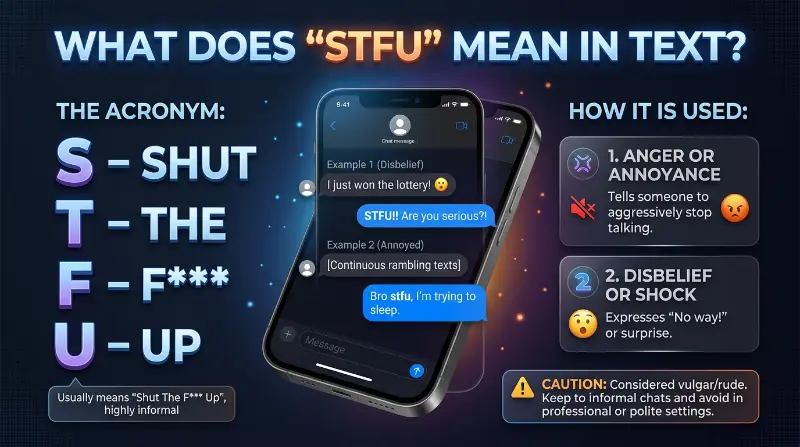
STFU stands for “shut the fuck up.” It is a vulgar internet abbreviation used to tell someone to stop talking or be quiet. Among close friends, it can also express surprise or disbelief, similar to saying “No way!” However, it can sound insulting or aggressive, especially during an argument.
What Does STFU Stand For?
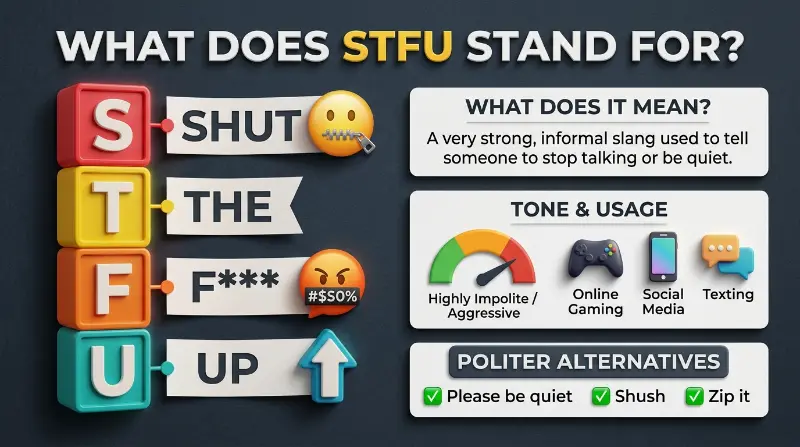
STFU is an initialism formed from the first letters of “shut the fuck up.” People use it in text messages, online chats, social media comments, and other informal digital conversations.
The expression is much stronger than simply asking someone to be quiet because it includes profanity. It may communicate anger, frustration, impatience, or disrespect.
For example:
- “STFU and let me finish.” — A forceful demand to stop interrupting.
- “STFU, you actually met him?” — A possible expression of surprise or disbelief.
- “Can you STFU for a minute?” — An irritated request for silence.
Although the abbreviation is short, its emotional impact can be strong. Readers should consider the surrounding message before deciding exactly what the sender intends.
What Does STFU Mean in Texting and Social Media?
In everyday texting, STFU usually tells someone to stop talking, arguing, or making a particular comment. Its tone can change depending on the situation.
1. Telling Someone to Be Quiet
This is the literal meaning. Someone might use STFU when they are annoyed, frustrated, or unwilling to continue a conversation.
Example:
Person A: “You keep making the same mistake.”
Person B: “STFU. You don’t know the whole story.”
Here, the response sounds defensive and hostile. The sender is trying to stop the criticism rather than discuss the issue calmly.
2. Expressing Surprise or Disbelief
Friends sometimes use STFU as an exaggerated reaction to unexpected news. In these situations, they may not literally want the other person to stop speaking.
Example:
Person A: “I just found out we’re going to Paris next month!”
Person B: “STFU!! Are you serious?”
In this conversation, STFU expresses shock and excitement. The second sentence helps clarify that the sender is surprised rather than necessarily being aggressive.
3. Teasing Someone Playfully
Close friends may use the abbreviation jokingly when they are laughing, sharing gossip, or reacting to an unbelievable story.
Example:
Person A: “I accidentally sent my teacher a meme meant for my best friend.”
Person B: “STFU 😂 What did your teacher say?”
The laughing emoji and the follow-up question suggest playful disbelief. However, not everyone is comfortable with profanity, so this style of joking depends on the relationship.
Is STFU Rude or Offensive?
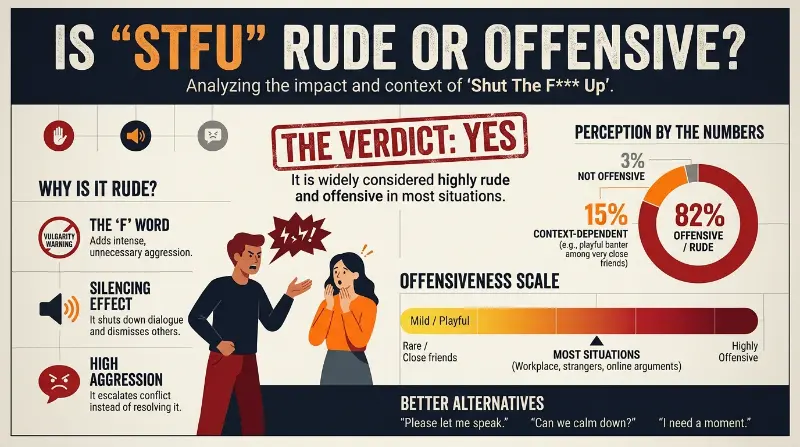
Yes, STFU is generally considered vulgar and potentially offensive because it contains a strong swear word. It is often interpreted as an insult when directed at someone during a disagreement.
However, its tone is not always hostile. Close friends may use it casually to express excitement or disbelief.
| Situation | Possible interpretation |
|---|---|
| An argument | Anger or disrespect |
| A surprising announcement | Shock or disbelief |
| A funny story between friends | Playful teasing |
| A message to a stranger | Rudeness or hostility |
| A professional conversation | Inappropriate language |
These interpretations are not absolute. The sender’s wording, relationship with the recipient, and previous messages all help determine the intended tone.
If someone sends only “STFU” without any other context, it is reasonable to interpret it as a potentially rude command until you have more information.
How to Respond When Someone Says STFU
Your response should depend on how the message makes you feel and what the other person seems to mean. You do not have to respond with the same language.
If They Are Joking
If you know the person is joking and you are comfortable with that style, you can respond casually.
- “LOL, why are you so shocked?”
- “I knew you’d react like that!”
- “Wait until you hear the rest.”
If They Seem Angry
If the person appears upset, a calm response may help prevent the conversation from escalating.
- “Please talk to me respectfully.”
- “What’s bothering you?”
- “We can discuss this without insulting each other.”
If You Are Unsure What They Mean
When the message is ambiguous, asking a simple question can help.
- “Are you joking or are you serious?”
- “Did I upset you?”
- “What do you mean by that?”
If the person continues to insult or harass you, you can end the conversation rather than argue. You are not obligated to engage with abusive messages.
Polite Alternatives to STFU
If you want someone to stop talking without using profanity, several alternatives communicate the message more respectfully.
| Expression | Meaning or tone |
|---|---|
| Please be quiet | A polite request for silence |
| Give me a moment | Asking for time to speak or think |
| Let me finish | Asking not to be interrupted |
| Let’s take a break | Suggesting a pause in the conversation |
| Please stop | Asking someone to stop a particular action |
| I need some space | Setting a personal boundary |
The best alternative depends on your intention. For example, “Let me finish” is more appropriate than STFU when someone keeps interrupting you during a discussion.
Similar Abbreviations You Should Know
Some internet abbreviations also contain profanity, but they do not all mean the same thing.
- GTFO: “Get the fuck out.” It can tell someone to leave or express disbelief.
- WTF: “What the fuck.” It expresses confusion, shock, or frustration.
- STHU: “Shut the hell up.” It is another forceful way to tell someone to be quiet.
- LOL: “Laughing out loud.” It commonly expresses amusement.
- SMH: “Shaking my head.” It often conveys disappointment, disbelief, or disapproval.
STFU focuses on telling someone to stop talking, while WTF usually expresses a reaction to something confusing or surprising. GTFO has a different literal meaning, although it can also communicate disbelief in informal conversations.
Is STFU Appropriate for Work or Formal Messages?
Generally, no. STFU is too vulgar for most professional emails, academic writing, official documents, and formal conversations.
Using it with a manager, teacher, customer, or unfamiliar person could damage the relationship or make you appear disrespectful.
If you need to disagree with someone professionally, use a clearer and more respectful expression, such as:
- “I would like to finish my point.”
- “Please let me explain.”
- “Let’s keep the conversation respectful.”
- “Could we pause this discussion for a moment?”
These alternatives allow you to express frustration or set boundaries without using offensive language.
Key Takeaways
- STFU stands for “shut the fuck up.”
- Its literal meaning is a forceful command to stop talking.
- Friends may use it playfully to express surprise or disbelief.
- It is vulgar and can easily sound insulting or aggressive.
- Polite alternatives are better for professional conversations and situations where the tone is unclear.
Frequently Asked Questions
1. What does STFU mean in a text message?
STFU means “shut the fuck up.” It usually tells someone to stop talking, although friends sometimes use it to express surprise or disbelief.
2. Does STFU always mean someone is angry?
No. It can be playful when close friends react to surprising news. During an argument, however, it is more likely to express irritation or hostility.
3. What does STFU mean on social media?
On social media, STFU has the same basic meaning as in texting. It may be used in comments, private messages, or online discussions as a rude command or an exaggerated reaction.
4. How should I reply to STFU?
If it seems playful, you can respond with humor. If it sounds insulting, ask the person to speak respectfully or clarify what is wrong.
5. Is STFU a bad word?
STFU contains profanity and is generally considered vulgar. Even when used jokingly, it may offend someone who dislikes swearing.
Conclusion
STFU means “shut the fuck up,” a vulgar abbreviation used in informal digital communication. It can be a direct command to stop talking or a playful reaction to surprising news. The surrounding conversation helps reveal the intended tone. When in doubt, choose a respectful response instead of assuming the sender is joking or deliberately trying to offend you.

My name is Tayyab Abbas, and I am the lead content author at TermsDefine.com. Holding a Master’s degree in English along with 5+ years of dedicated linguistic research experience, I focus on transforming complex terminology, word definitions, and technical jargon into clear, easy-to-understand explanations. Every entry, context guide, and meaning published on this platform is thoroughly researched, drafted, and verified by me to maintain the highest standards of accuracy and real-world clarity. My objective is to provide readers with an authoritative, dependable dictionary resource for all their vocabulary needs.